Vacation has come and gone (it was wonderful) and, with it, a decent backlog of book reviews (of course). First up - the second book I had taken out of the library along with That Summer, on that Friday afternoon trip - the next Flavia de Luce. This is the book that brings us the change of scenery - away from the English countryside, to the cold corridors of a Canadian girls boarding school. There's definitely what to be lost from Flavia's family's, friends', and neighbors' absence. Does the presence of the teachers and pupils of Miss Bodycote's make up for it?
Maybe not entirely, but certainly the old-fashioned boarding school has its own charm. Certainly for me, it has a similar far-away old-fashioned comfortable feel as old England. And if the students can't quite compete with Dogger, Mrs Mullet, and the village, they are certainly new and interesting. So I don't entirely mind the change of scenery.
I feel though, that with the loss of Buckshaw and the village, the book turns more in the direction of its immediate predecessor - less about life + Flavia's little investigation, more about some serious stuff going on. Flavia spends a lot of time trying to figure out what exactly is going on at the school, not as much figuring out the dead body. It all comes together of course - but the tone is different when Flavia is part of the mystery, not just solving it. More confusing, less cluesy. Of course, the story of the dead body gets resolved in the end, but I'm not sure how much of a resolution it was. We find out that Miss Bodycote's is a school for spies, but we knew that already. And what they do or what it's about isn't really clear.
And with that, if I remember correctly (pretty bad I don't, it hasn't been *that* long, I think I finished this on the plane on the way to CA, which was last Wednesday night), Flavia ends the book journeying back to England. So what was the point of this interlude? I'm not quite sure actually (it would probably help if I remembered better :))
So basically, we lose the village and much of the light-hearted tone. Flavia herself, while just as capable, does seem a bit out of her depth in this mysterious place. And the plot itself doesn't *quite* tie up all the lose ends. With all, Flavia is a pretty talented young lady and the boarding school is an enlivening place. So I guess I didn't mind too much that I, like Flavia, felt a bit lost throughout this book.
Verdict: 3/5
Showing posts with label mysteries. Show all posts
Friday, February 3, 2017
Tuesday, November 22, 2016
A Turn of the Page
Well it's been a while... I had one last book to review of my library haul, the one I was so excited about after the last book of my last library set - the next Flavia de Luce. I finished it over Succos but, since I had no more library books, just took me a while to get to this review. So anyway - I was excited to read this book because 1) I very much enjoyed the one before this and 2) the ending of the last book left open some juicy possibilities - namely, Harriet's return.
Well, as I maybe should have guessed, Harriet's return was not really that - merely, they found her body and returned it to Buckshaw. Not just not the happy ending we could have had - but, in fact, very sad, as the de Luce's had to confront the certainty of Harriet's death. So quite a bit more serious for that reason alone.
But that was really the least of the differences in this book from previous ones. The mystery in this case is not the murder of a random villager, with Flavia pottering around and solving it in her own way. There is a murder, but it takes second fiddle to Flavia's exploration of her mother's past. Definitely somewhat interesting to get a backstory but we lose much of the country village charm of the earlier books. And on top of that, uh wow, quite the backstory. Spies, heroes, villains - not your staid old English family. I mean, it's cool that Colonel and Harriet were so awesome, and makes some sense, seeing their talented offspring. But it's a bit of a leap from past books.
And at the conclusion, even more of a leap. We are asked to believe that Flavia is specially tasked with taking over the mantle of the family business (spying and whatnot). And that her sisters' resentment of her is rooted in jealousy of her position. And that she now has to be taken away to be properly educated. It's all just rather out of the blue.
But I suppose Alan Bradley was getting bored with the old formula and wanted to move things along. I get that. Now, I guess, we'll get some new mysteries set at Flavia's boarding school? Guess we'll see. I hope wherever they are, they are back to their old charming form, not too full of backstory.
Verdict: 2.9/5
Friday, October 14, 2016
Livening up Idyllic England
Well, I finished the last of my library books. Was two weeks ago already, in between was Rosh Hashana, Yom Kippur, so I've been busy. Also semi-deliberately not reading the usual :) Now it's Shabbos again and I have not been back to the library to get more books, so oh well there. But meanwhile, let's get to that outstanding review. The last of the library books was another familiar author, Alan Bradley of the Flavia de Luce series. There have actually been 3! new Flavias since I last read one, but I only picked up the first of these for my trip. I like Flavias mostly because of the setting (and by setting, I mean not just the time and place, but the tone) I think (English countryside in the fifties) and definitely somewhat for Flavia herself, a... unique... preteen whose detecting capabilities (among others) are admirable. The mysteries are fine as mysteries go, you know I'm not much for mysteries per se.
This book delivered much of the same bucolic countryside, unflappable Flavia, and host of English-village side characters. The mystery was, I think, also similar (TBH, I do not much recall the previous mysteries ;)). What I would say about this mystery (which I think is common to the series) is that there is almost an over-abundance of clues. It seems like the answers could be gotten much sooner, or that many of them will be red herrings, the way the plot, and Flavia's mind, jumps from point to point without resolving any of them. But in the end (as far as I recall), it's mostly all resolved to satisfaction by Flavia. Like I said, I don't read the books for the mysteries, so the framing of the narrative in terms of clue-finding is not very important to me, but I am happy it's all resolved, nice and neatly.
What's more interesting is Flavia's day-to-day life, which, I was little surprised at, actually evolves somewhat in this latest book (the blue one is the way I think of it :) It's actually called Speaking From Among the Bones). Flavia's relationship with her sisters and her father deepens, Buckshaw is for sale... and a final cliffhanger about her mother! Very exciting :) I always wanted these books to go somewhere and now maybe they finally are. Excited to read the next book, which yay! is already published and readily available whenever I go get it ;) And meanwhile, I continued to enjoy Flavia's peregrinations about Bishop's Lacey and chemical explorations in her lab and certainly look forward to more of that as well.
Verdict: 3.75/5
(update after searching for an image - there have actually been 5 new books, counting one just released. Wow this guy is as prolific as AMS :))
Thursday, June 9, 2016
10 Books In, Has the Premise Run Its Course?
Well I finally did it - almost 4 years after my last trip to the library (August 2012), I put my kiddos in the car and drove the (very short) drive (could have walked but then would have had to deal with the stroller) to the Edison library. Excitingly enough, this library is less than a 10 minute walk from the house, and right near the train station where I come/go every day, but it took me this long to get there (and I lived for over a year in Carteret without ever taking a book out there (used the Manhattan library though) and in HP without even getting a library card, but anyway). So what was my first pick? Lauren Willig of course. I think I even wrote on an FB post on her page once that it would be. How embarrassing :) I didn’t have much browsing time, I got one more book (more anon of course), but let’s just focus on Willig first.
So as you know ;), I’ve been reading these books for a long time. They are favorites of mine because they are regency romance but not the romance genre (have more literary pretensions). They are also of the historical mystery/drama genre, but less so than, say, Deanna Raybourn or Tasha Alexander. Anyway, Regency, romance, not trash, and nice and light. What’s not to like, of course. So yeah I do like these books. In recent years (well not that recent), I have noticed a “sameness” about them, and also somewhat liberal anachronism and silliness, so I can’t say I find them *that* well-written, but you know, they are pretty good. Neat enough phrasing, if a bit too pat. So that’s in the past few years. (I have read her books since I stopped going to the library, since I own two of them, so it’s not going back all that far necessarily. You’ll have to read old reviews to see how far it does go back ;). On top of this recent impression, and really more along with it, I think I have less tolerance for empty romance than I used to - I need something more in a book than an implausible romance and less-than-mediocre writing. Not saying that describes Pink Carnation books, just that my tastes have changed (matured, perhaps :)) in that respect.
So anyway, back to this particular book, it’s about Miss Gwen (I was, by the way, 3 books behind in the series, as well as not having read the 3 non-Pink books written in recent years, so quite a lot of material :) This was the least recent of the series books.) Miss Gwen is Jane’s companion, a lady of mature years and prickly demeanor. So not the most endearing of characters, at least as the heroine of a romance. The book is supposed to show her softer side, but I’m not sure I want to see her softer side. I liked her as the steely chaperone Miss Gwen, more ambivalent about “Gwen”. The Captain is a debonair and likable figure, but I’m not sure I buy the romance. It’s not forced or anything, just rather… shallow? Here’s where I’m not sure if I’m just picking up on the “sameness” thing (so boring because same), if the books have gotten worse, if my tolerance is lower, or if I really just don’t like seeing Miss Gwen’s softer side. Here’s hoping it’s the last, since I like being able to thoroughly enjoy my books.
Not that I didn’t enjoy the book. It was light reading, which I never mind. It had romance, it had some action, I guess a few laughs. It had characters I care about and the setting I love. So can’t really complain, and look for reviews of the last two books of the series shortly :)
Verdict: 3/5
Wednesday, February 25, 2015
The Past Can Be Refreshing
Story of this next one: We walked to Goldie and Aharon's baby's bris and Esther Twersky offered to let me nurse in her house since she lives right near the shul. I took her up on it, and she very nicely offered me a choice of reading materials. She had lots of exciting used book, childhood favorites type. Plenty of Gordon Korman, and she also had this author Keith Robertson. He's the author of the Henry Reed books, which I used to read back in the day (and more or less enjoyed), but apparently he's the author of several other books as well. I selected one of them, The Money Machine, started it while I was nursing, and took it home with me to finish.
The book is a children's mystery, with that old-timey feel of Henry Reed, Beverly Cleary etc - when children got around on bicycles, did their chores and lived wholesome and energetic lives. The protagonists of The Money Machine (it's actually the last in a series with these boys) run a detective agency. The mystery involves a counterfeit ring. Not *too* high stakes, but of course, seriously dramatic for high school. I'm not a huge fan of mysteries for their own sake, though I read many of them for various reasons of course. So the actual clue-tracking and culprit-exposing wasn't overly important to me. What impressed me more (I mean that in the sense of made an impression on me) was the old-timey feel of it all. The mild manners, the slow pace, the secure atmosphere - all make for a relaxing read, despite any tension that arose from all the tight spots that happened along the way. Not that I'm particularly nostalgic, and definitely not nostalgic for a time and place I never knew, but the wholesomeness of all did get to me.
At least I think that's what it was. The bottom line is I found it to be an easy read. As a children's book, I wouldn't have expected much else. Even so, I think the old-fashioned neat-and-cleanness contributed plenty.
Verdict: 3.5/5
Tuesday, January 7, 2014
Elementary, My Dear Readers (Yes, I know this isn't even really from the books)
It's been a while since I'm back on the train and 4G (back on the train now in fact), but (no surprise) I have emerged from the subway with the task of reviewing several more ebooks. There were a few other choices outside of the children's classic genre - for one thing, I read all but the last collection of Sherlock Holmes short stories (the last wasn't free :)) The stories are all the same, but not the less addictive for that. I found myself "deducing" to Dov when not reading the stories :)
I remember one of the Sp's, (I think Shy.) pointing out that Sherlock's cleverness is implausible - many of his "inevitable" deductions are not inevitable at all, and he's only brilliant because he's right (in other words, his methods would not work in the real world). This is definitely somewhat true, but who cares? 1) He's awful smart for a' that :) And who doesn't want to read about smart, successful people? 2) Even though I know the cases are just crafted by the author for a specific reveal, it's still enjoyable to see the way the ends are cleverly tied up. I get a lot of pleasure out of well-tied up plot strings :) Even in the cases where I had a vague notion of the solution (and that was most of them, since this is not my first reading of Sherlock Holmes) I liked seeing how the details were resolved. And I'm not a critical reader, so even if the resolution wasn't perfect at times, I mostly missed those gaps.
After a while, of course, these stories are just all the same - that's expected. But they can still be clever and amusing for all that. Not enough to make me pay for the last set (though maybe I would have if I hadn't found other reading materials), but you know, quite enough to enthrall me while they lasted.
Verdict: 4/5
Labels:
classics,
English,
historical,
mysteries,
short story
Tuesday, July 17, 2012
Storms In The Teapot
So The Limpopo Academy of Private Detection was actually somewhat of a departure from this. A departure in that personal issues really took front and center - and they mattered. I suppose Mma Potokwane's orphanage isn't really directly related to the mains, but Mma Ramotswe certainly feels her pain sharply enough. And of course Fanwell's trials and the suspicious circumstances of Mma Makutsi's house are closer still. So the mood is just a little more... I don't know dark, but definitely more serious than usual. With that still, we know everything is going to be alright (well we know that, because AMS was not about to write a tragedy) - but we *feel* it's going to be alright too. Maybe that's because the book is actually fast-paced enough to deal with all this in pretty swift fashion. In fact, it almost feels at times like a a real detective story :) In the way the action moves along and clues are discovered. But don't worry, not too much action, at least I didn't feel that way.
So some of the charm of the earlier books wasn't quite as present here as usual. And I'm not sure I'd be a fan of many books in a row where all this happened. But certainly, it was a good read this one time. And Clovis Andersen's appearance was definitely an added bonus! All in all, all remains good in Botswana. Not bad for number, was is it? 11? 12?, AMS.
Verdict: 3.75/5
Wednesday, March 28, 2012
The Hand of a Master, Even If the Medium Is Different
Well I finished my books on reserve... and found myself, perhaps due to neglect, with a zero-length backlog. So I was free to pick up whatever I fancied, as long as I could get my hands on it. That of course, limited me to Georgette Heyer and a few other choice favorites I have in my possession. I did, indeed, choose a GH, but the question is, which one? The only one I've read at all recently is Venetia (and I'm not sure how recently that was, since I don't think I reviewed it on the blog) so I had many old favorites I could turn to... then there were those that I like, but that I didn't buy on the first round since they aren't *that* good... and then there's The Quiet Gentleman, which I picked up last summer from the Border's going-out-of-business sale (see if you can find the other book I picked up reviewed here :)) simply because they had it. This is one I've read once (back when I first read them all and got out the last 10 or so from Pratt library) and I don't think since then. It's more a mystery than a romance, like Regency Buck, but only the mystery parts. But Gital (Dov's cousin - is this the first time I'm mentioning Dov? maybe :) - nope, just checked, two other times - I guess he does figure quite largely in my reading life :))) mentioned that she liked it (she got into GH a few years ago and has been reading them slowly, I gather) and that was somewhat of a recommendation. Plus Jennifer Kloester's Regency World kept mentioning Gervase Frant of all heroes. So I was ready to give it another go.
It is indeed, more a mystery than a romance - and mystery is not GH's strong suit (not that it would matter much if it was, since I don't go in much for mysteries no matter how good they are). But in any case, I've never read any of her actual mystery, but her other romance + mystery is really Regency Buck (though that one is more of a romance / tour of Regency society than a mystery) and I found them quite similar - mostly in the dispositions of the villains, who were both refined, almost smarmy, and overtly concerned for the interests of their victims. But if the meat of the book was the mysterious accidents that befall Gervase and the fallout from his return to the family seat, there was plenty of distraction in light flirtations, balls, and pleasant conversation. So don't get me wrong - this book was not hard to read.
In fact, I'd say TQG made me appreciate GH all the more. Even in a book with little romance, and between a couple I couldn't really get behind for much of the book (I appreciated Drusilla's practicality from the beginning but Gervase did not seem to be "one of the downy ones" until much later and it was hard to see his coolness at first), it was just so much fun to read. The usual stock characters, the practical heroine, and everything moving along so delightfully. I'm not saying this book was a favorite, or even that I'm surprised I haven't read it in years, but I'm not sorry I own it, and I'm sure it'll make its way back into this blog (if it's still around :)) a few years from now.
Verdict: 4/5
Thursday, March 22, 2012
Almost, But Not Quite, More of the Same
Remember way back when, through the fog of time, this blog was a newborn babe, and I did other things besides reviewing every book I read, methodically? It was a short but sweet time, glorious in its variety. Oh how I miss it... but nothing remains the same, not forever anyway... All right, enough nostalgia. The point is, one of the first reviews I did, about a book I had read before I started the blog, was The Spellman Files #4. Last year (I think it was last year), I read and reviewed Lisa Lutz's stand-alone, and this year, I'm back to #5. I think we were all a little surprised that there is a #5, since #4 ended off just fine from my POV. But she chose to write a #5, and if I have gleaned properly from the website, there's more where that came from! Sarah Sp. has not been happy with her since at least #4, and I think #3 too, so she wasn't very enthusiastic about the continuation. My feeling was that Isabel was with Henry, and all grown up, so why go further? And yet, here we are.
Two years into the future that is (and we actually *are* two years in the future, how funny :)) Isabel is with Henry, Rae is in college, and the ex-convict Isabel liberated in the last book has taken up residence with the Spellmans. Isabel herself has not regressed in maturity, I'm happy to say. Other than the slight irregularities that are a product of her personality (and perhaps Lisa Lutz's) she appears a stable, relatively successful adult. The rest of her family is up to their usual antics, but they were never as crazy as Isabel. So to start off with, less self-destructiveness and just as much harmless zaniness as before. I think it's a change for the better. The plot itself is mostly harmless too. I have to say I don't have that much of a memory for previous plots, which suggests they are mostly of the same nature as this one - lots of meandering threads that get somewhat loosely enmeshed towards the end. I think it's Spellman as usual, for most part.
But Spellman as usual can get irksome after 5 books. Rae is definitely not aging gracefully. And I find the unnecessary rudeness and shenanigans... unnecessary. And maybe it's just this book, but I feel like I can very much hear Lisa Lutz writing. Isabel is funny when we're laughing at her and her insane family. But if Isabel is right in her "quirky" view of the world, even a little bit ... well what's there to laugh about? I guess what's left is a certain cleverness in the antics. I definitely stayed curious the entire book, through all the plot twists and jumps. There is the little annoyance of *constant* event-droppping (just coined the term) where all we hear is "we'll get to that later". If *you* know, we want to know too! Get that through your head. But I guess it's just par for course with the Spellmans... even though I bet Lisa Lutz could write a whole book in chronological order and I would still find it interesting. Really, she should try it.
ANYWAY... why am I going on and on about this? It's not like I care about any of this (ok not like I care *most* about any of this :)) What's going on with Isabel and Henry? Of course that's the question on all your minds :)) And first, let me say that, in book #5, I would have been just fine with letting I&H fade into the background as a mature couple - their story was well-played out already. What I am NOT fine with is them breaking up! I will however forgive LL if/when they get back together in #6. I'm betting they will, because otherwise, what was the point of breaking them up? To be realistic? I mean, really? I'm definitely going with engagement in a book or two. But even with that, I'm not sure we needed a breakup now... Oh well, what's done is done. 'Twere well it be repaired forsooth.
Verdict: 3/5 (I don't know, I just didn't find it at all hard to read)
Thursday, December 29, 2011
Approachable Star, Approachable Story
After a hiatus of, what has it been, 3 weeks? and 1 book, I'm back with *yet another* AMS. This one actually just published, the latest Isabel Dalhousie. I've reviewed at least one of these before on the site, but I'm not going to go back and read it, because, as you know, I like my reviews fresh :) This series is the least popular one amongst the Swia. public - that is, the Sp's don't even read it. It used to be my favorite, since it featured a very satisfying, if a little unusual (the unusual is what bothered the Sp's) romance. But that's been long over (or long-settled), so what's left? Isabel herself and her many musings. AMS is fond of philosophical ramblings of course, but in these books he's given extra license to digress on whatever he fancies, possessing of the perfect mouthpiece in one who philosophizes by profession.
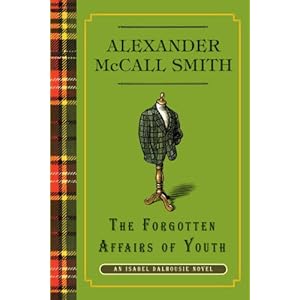
As you can imagine, that can get annoying. Especially when I disagree with Isabel, but also because spending so much time delving into every perceived moral dilemma does not make for thrills and chills all day (not that that's what I'm looking for anyway :)) And at times, that was definitely my prevailing feeling while reading Isabel #... 8? I think it's 8 - The Forgotten Affairs of Youth. She goes on and on about this or that and my feeling is, it just doesn't matter that much, lady. AMS presents her as the gentle, refined, and cultured woman, but it's hard not to find her boring at times. And because she's boring, she becomes unlikeable, since AMS is so clearly enamored of her carefully crafted thoughts, feelings, and lifestyle (in other words, we have a Mary Sue).
That was sometimes... and more at the beginning, I'm glad to say. As usual, somewhere along the way, the pace picked up. But it wasn't just the plot development - interestingly enough, I actually found myself liking Isabel, a lot more than I have in a while. For once, she isn't left as this rather inhuman pillar of morality and thought - to a much greater extent than I think ever (or at least in the past few books) previously, we are invited into her inner life. A vacuous phrase, but what I mean, we see how much she loves Jamie and Charlie, how she cares about Grace, how she gets frustrated with Cat. These are things we know about, but I think not ones that took as central a role before this. Even the obligatory "mystery" feels more personal, more about Isabel meeting people than about finding something out. And I think it's a good change. It's amazing how important it is to like the people you are reading about. And in this book, I find that I did like most everyone. Cat was annoying as ever, but AMS acknowledges her "impossibility" with that very word (maybe in a different form, but that root :))
The plot itself may have been a tiny bit lacking, in that, except for the central story, loose ends were for the most part not tied up. Not sure what happened with Charlie swearing, with Max Lettuce, with Sinclair+Cat... but I guess none of those were very important, and that was the point. It was all about Isabel and how she handled them - and I think she did it very well, getting it right and keeping it real too. Isabel is fun again, at least for the moment. (Ok, not sure she ever was, but she certainly wasn't always as stodgy as lately).
Verdict: 3.25/5
Wednesday, December 21, 2011
Too Short to be Really Sweet
Wow it's been a while... indicative of my tiredness every morning, my busy Shabbosim (Bubby, the in-laws...), and a slightly lengthier (well maybe just really slightly) work, and well, yes, one that failed to hold my interest consistently. It's an Austenprose pick, and in a big way - Laurel Ann, proprietress of Austenprose, edited a collection of short stories from Janite writer - mostly of JA paraliterature - with the common theme of somehow being inspired by the woman herself. This book was not at the library when it came out, but I was eager to read it, since not only did Laurel Ann talk about it pretty incessantly, but Lauren Willig and Margaret Sullivan (Austenblog) contributed, so they mentioned it as well. So I told Dov to buy Jane Austen Made Me Do It for me from B&N when he wanted to get me a present for Succos - yes, Succos - well actually, the last days. But you know how it is - if you own it, you don't read it. Which is why it had to wait for my library backlog to empty in order for me to pick it up.
I did pick it up of course, I think over two weeks ago now. The stories are, of course, completely self-contained, so there's very little compelling you to go on to the next when you've finished one. And they, also of course, held varying degrees of charm, humor, and romance. The genres were (I might be dropping a story here or there), in parallel with Austen paraliterature as a whole, sequels/prequels/durings of the novels, real-life Jane Austen stories, modern spooky Austen ghosts, and chic lit with an Austen touch. Of these, I'd say the ones I enjoyed the most were the last, which is kind of sad, since a lot of those were quite tangentially inspired by Jane, I'd say. But of course, that gave their authors the freedom to develop plots/tones suitable to short stories. So many of the others (well ok, some of these too) felt like they could have made promising novels... but the first lesson of short story writing is... a short story is not a novel. Back in ninth grade, we studied some characteristics - irony and whatnot - but the point is, you need to manage to develop something we care about in only a few pages. Or it just kind of falls to nowhere.
I'm not saying the stories were that bad - some of them were cute ideas, and one or two (sadly it was really only one or two) had decent romances going on. There were definitely some I'd be excited to here were going to turn into a real novel (one, I think it was the Rubino one mentioned there is some possibility) and plenty, that, up to the abrupt ending, I was getting into. Not surprisingly, most of the ones I liked were the authors I like. Lauren Willig, Rubino, Jo Beverly (ok, I don't read her, but she's a legit romance writer, not Austen paraliterature) but surprisingly, I enjoyed the amateur one and Laura Viera Rigler's tales as well. In short, these authors are people (mostly women :)) after my own heart. There could be nothing too objectionable in a few pages meant to amuse. And indeed, I found nothing to object to... but nothing to make me wish for a sequel either.
Verdict: 2.9/5
Monday, November 21, 2011
A Cozy Setting For a Nice Murder
Second English historical mystery series in a row! This one not a romance in any sense though (I hold out hope for the future, but it'd have to be a long time in the future :)) I have just completed Alan Bradley's Flavia de Luce #4, I Am Half-Sick of Shadows (quote from The Lady of Shallot, as is helpful cited in the front of the book). #1-3 are of course (not of course, of course, because if I had started them over a year and half ago, it wouldn't be the case) reviewed elsewhere on le blog, but I am going to go courageous route (for the second time in a row) of not reading my previous reviews before writing this one. Actually, of course, that makes my task a lot easier, since I never repeat myself if I can help it (and clearly I can't if I don't remember what I wrote :)) Though I have to admit, for someone who likes to original, my reviews can get pretty uniform... but I digress.
The Flavias are fun because Flavia herself is quite the character, and because so many of the other denizens of Buckshaw and Bishop's Lacey are worthy of gracing the pages of a Dickens novel (oddly specific, but that's what they are - quintessentially English, somewhat one-dimensional (or is it 2d? In any case, flat) but oh so detailedly perfect in their roles. The setting is PG Wodehouse meets Agatha Christie meets... well really, meets Homer Priceian small town insularity. (And that's leaving out echoes of I don't know what in Flavia herself, who combines an agile mind and talent for sleuthing with the confused pre-teen perspective on life). And the mysteries are always well-crafted, if a little too... well, a little too mystery-ish for my taste.
#4 is a Christmas tale, I think actually a Christmas special, so it's a little shorter than usual, though still well crafted. The scope of the tale is smaller, with all the action taking place at Buckshaw (in a snowstorm) and within a few days (right before Christmas). On the other hand, the case of characters is entirely (well not entirely) new, as a film crew has taken up residence at Buckshaw. The variety is, I think, welcome, if only because too many murders in one small town might become ridiculous (though the film crew isn't all that different from Rupert Porson's traveling puppet show in #2). The shortness of the book means we get less of Flavia doing things besides solving the murder, or at least getting distracted while on the trail (less of Inspector Hewitt too, I think). And the mystery is solved a little too easily - I'd say before Flavia should have had a chance to put it all together (she figures it out by talking to enough people, but i think things fall into place a little too easily). But that's okay, it's a good enough mystery for me.
What's more important? Well I didn't love the ending - I think I remember thinking that the first book had too melodramatic a finish and Flavia's close brush with death continues here, I think just as implausibly. Though Flavia investigates real, live murders, she never seems to get involved enough for it to seem possible their sordid surroundings to touch her - and yet they do. It's almost an unevenness of tone... one that is evident in a few more places in the book. First of all, it never does become very clear who are the good guys and bad guys amongst the book's newcomers. I don't mean the killers, obviously they're bad guys (well ok, I guess sometimes the killers aren't bad guys, but they are this time). But everyone else... the victim, her maid, the set guy (don't know his title) the second-in-command set guy... they all seem mildly unpleasant, but we never really get their personalities resolved one way or the other. And, more severely, Flavia herself continues to exhibit a strange mix of vulnerability and cunning, cut to the core by her sisters' cruelty, yet utterly unmoved by some pretty scary stuff. That is, of course, Alan Bradley's intended portrait of Flavia - but it's a picture that doesn't always blend easily. These are all minor details though, overall I find myself quite carried along by the olde-English way of life and its various livers (wow that sounds funny - but it's the right word, it is :))
So what do I really want more out of this book? Well I want a full-length novel, because I believe AB can do better with 100 more pages or so. And I want someone to explain to me what in the universe is with the dL family anyway?! It just gets a little too weird sometimes, Harriet's presence and Father's distance, Daphne and Ophelia's harsh treatment and their very occasional lapses into human decency... oh, and why is Flavia never in school? I think it's high time we get some answers, but I don't know if we will any time soon (I should probably look that up, I bet he's answered that in an interview somewhere). And of course, let's get Flavia some romance! A few years in the future of course, she's immature even for an 11-year-old. Personally I'm rooting for Dieter to throw over Olivia and get together with our heroine, in the fullness of time... you never know :) And meanwhile, I'll keep reading for kicks.
Verdict: 3.5/5
Wednesday, November 16, 2011
Less Compelling, More Amusing
More familiar writing... I just reviewed the new Deanna Raybourn, so of course the new Tasha Alexander couldn't be far behind. I actually deliberately did not reread my previous reviews (I think there are two on here) before writing this, so I have the benefit of reviewing this one entirely on its own merits :) As you know (or would know if you read this blog regularly and remembered it, finger-wiggle :)), I am not an unabashed fan of Tasha Alexander's style. While I prefer her lighter touch and the more familiar Victorian England it generates, her writing has always left something to be desired. This book is no different, with high-flown statements that don't come off as grand as they are meant to sound, tender moments that seem more awkward to me, and passages that just don't flow sometimes. I realized while reading this that TA is a prime example of an author who violates the "show, don't tell" principle (which I may have, kind of, sort of, invented :)). I don't care if Emily is overwrought, highly disturbed, angry, confused, horrified, grief-stricken.... I want to feel that myself. And so many times, I'm instead caught by surprise by Emily's reactions, since, while they may be perfectly legitimate to someone experiencing them, we the readers don't come close to that status, and instead are relegated to the post of distant observers.
But enough of that - yes, these books could be better-written. But I have to say, I had no trouble at all getting through this one. Yes, it's not that long, and the slightly bald style means little concentration is required. But it wasn't that - I thought the plot - public exposure of private scandal + clues to a murder hidden in the British museum - was rather innovative, and definitely absorbing. It wasn't just a whodunnit (though it was a straight detective story, don't get me wrong, not much history/thriller/fantasy thrown in there). And even though the stakes were high, I never got too nervous... ok, maybe that's because of the writing :) But our main characters had more fun than worry sorting through the whole mess (or if they didn't, we did at least). Admittedly, when the mess was sorted I found myself a little disappointed - the villain was I thought, a fairly obvious choice from the beginning, and most of the loose ends were tied up any which way, with little coherence to the main resolution. But you know, at least there was ending, tidy, peaceful and everything necessary.
Oh and side note that's not really a side note, Lady Emily's eccentricities were considerably less emphasized in this book than some others. Yes, she still trumpets herself on her drinking of port and smoking of cigars (with the addition of whiskey) and she' active in the suffragette movement. But luckily, she's more occupied with detective work than anything else. And, surprisingly, in detective work she's happy to take a backseat to Colin, not insisting on being in on all the action all the time - this is a refreshing contrast from Lady Julia's shenanigans (or at least antics). We will never be entirely free from Ms. Alexander's less than subtle critiques of Victorian society, its social hypocrisy (actual the theme of this book), its restrictions on women, its downtrodden working class, but I guess we've heard it all so much before it just goes in one ear and out the other. And guess what, TA? If you didn't like the time period as much as I do, you wouldn't be writing about it, so I know you must not care all that much :) So let's all just sit back and enjoy a light and elegant tale of detection together.
Verdict: 3/5
Had to PS this one - I read my review from last year and guess what "tell, don't say"! points for consistency :)
Wednesday, October 19, 2011
Sleuthing, Victorian Style
Back to a familiar name and a familiar genre, the next book the library had ready was Deanna Raybourn's 4th Lady Julia (wait, actually it's the 5th), the 4th of which I reviewed last year on this very blog :) That review was all about the comparison between Tasha Alexander and Deanna Raybourn and the truth is, that's pretty much a lot of what I thought about while reading this one too, but I really think I should move on. (Don't worry, I'll come back to it anon :)) But meanwhile, let me try to review this one on its own merits.
So let's start of with what we can best expect from Lady Julia #5. Even in #s 1-3, before Nicholas and Julia tie the knot, the romance is very much not the focus of the book. It's quite intense and quite well done, but just doesn't take up that much space. These books are really serious mysteries, and mysteries with quite a fantasy element thrown in. Victorian mystery... that frustrating genre, so familiar and yet so removed from the lovely Regency settings of GH and co. It's amazing how much I love England (old-fashioned England especially of course), given that I don't know how much these books could hold my interest if they were, say, about little green men in a galaxy far far away. I also must not hate mystery all that much - or at least this type of mystery - more highbrow than whodunit. There is emphasis on Lady Julia and Brisbane's relationship of course, but also on various elements of Victorian London and on Lady Julia's numerous family. The pursuit of the case is subtle enough to keep the gaslit-fog atmosphere going and also exciting enough to keep the book moving. In general, Deanna Raybourn exercising her writing chops well.
Which brings me back to the subject of the last book's review, where I pointed out DR's far superior writing skill. There, I was left unsure whether the rather more intense tone outweighed the better execution, but here dark side was somewhat less manifest, perhaps because it was tempered by the civility of London as opposed to the wild Indian state of Darjeeling. So, although the spookiness factor of the book wasn't particularly low, it wasn't so intense as to be distracting. And one other significant difference - the ending, while I found it disappointing, had none of the dramatic and sudden death I had to contend with in #4. So what's left when all is said and done? And fairly exciting read about characters I've learned to care about whose relationship still holds some interest for me - not an unenjoyable read at all.
Verdict: 3/5
Wednesday, April 20, 2011
How Mattering More Than What
Okay, on for review of the first days' real reading material - Lisa Lutz's latest, a non-Spellman files joint effort at a comic mystery. It's amazing that I've been writing this blog so long that I'm getting up to authors' second new books since I started... but in this case, that's only because I posted about the book a while after I read it, so I don't know if it's time to start waxing nostalgic :) Anyway, I think we were all ready for the Spellman Files to end even before the last one, so we were certainly happy that this latest is entirely independent of Izzie and her gang (though there's Spellman #5 out next year, which I shall certainly be reading, don't get me wrong :)) But other than being non-Spellman, I don't know that there was much to recommend this project. It was an innovative idea, (or not hugely overdone anyway): Lisa Lutz and an ex-bf writer friend of hers would write alternate chapters, not discussing the plot beforehand. Let the story unfold how it would, with the only guidance that it be a whodunit, with some resolution at the end. I don't have any objections to the idea, but the descriptions made the book sound... well kind of horror-meets-kitsch, which just wasn't something that appealed to me all that much. And it's not like I adore Lisa Lutz all that much... I mostly read her books for the romance, though the comedy is none too bad, of course.
But of course, it wasn't like I wasn't going to read it... because, of course, I don't exactly have to expend much to put it on reserve at the library. And in this case, because my wonderful cousin Sarah Sp (see you really should read my blog ;)) is boycotting LL over her last book, the library was kind of my only avenue - which was just fine, because I put it on reserve months ago and got it immediately upon publication. ANYWAY... I'm sure you want to hear about the book already. The first thing I realized upon starting (just the intro, not even the book) was that the format was a big part, if not the whole point, of the book. Every other chapter belongs to either Dave or Lisa and in between, we get notes discussing the previous chapter between the two authors. So besides the unfolding mystery for Paul and Lacey, we get the story of how this book got written. Or not exactly that, more like a running commentary on all that was lacking in the previous chapter. And there are plenty of within-the-text jibes back and forth too. So that the characters sometimes voice concerns about the narrative or make a slightly out of place comment, clearly the message of the current writer to his/her counterpart. Whatever, the point is, it's funny. And we never forget just what is really going on in the book.
The mystery itself... well don't take it too seriously, that's for sure. First of all, my assumption is that most mystery writers have a pretty good idea of unfolding events from the beginning. I would think it's fairly difficult to produce a well-crafted whodunit, one with a really satisfying ending, without knowing where every lead is headed. But in this case, not only did the format make advance planning impossible, the authors didn't even try, forgoing narrative integrity for the chance to get the book at on Lisa/Dave's chosen track. But it doesn't really matter, it's not like this book was meant as a serious mystery novel anyway. And the back-and-forth, no-respect-for-reality bonanza of dead bodies and petty criminals makes that very clear. It also makes the book funny, at least in its own way. And I'll take funny over a good mystery any day.
I don't know why I'm giving this book such serious attention. It's really very simple. The book itself is okay funny when it's read as a farce, which I think is definitely as intended (I don't even think it's in the mystery section of the library). The far more compelling narrative is that between the two authors, as played out somewhat in their notes, and more within the main chapters. I'm pretty sure their petty jibes and textual battles are at least somewhat fictionalized, but I'm okay with that. They're still funny. Bottom line, I think Lisa Lutz sees herself more as a comic than as anything else, and I don't think anything in this book proves her wrong.
Verdict: 3.5/5
Sunday, April 17, 2011
Journey Once More to Far Off and Fairytale Lands
Just in time for my one year anniversary, I've got yet another AMS to review. I think I've done one from each of his series already (No. 1 Ladies, Corduroy Mansions, 44 Scotland Street, Isabel Dalhousie, and also one independent), and since it's been a year, he's back with another No. 1 Ladies. This was comes with some additional excitement for me, since I just went with Aunt Sarah and the lovely Sp girls (all except Ah!) to see the author in person. It was an NPR-sponsored event, so not free of, what was to me, intrusive liberalism, but the man himself was delightful, just delightful. He was polite, well spoken, quite amusing... I must say, more likeable than some of his characters :)
Anyway, I wouldn't say more likely then Mma Ramotswe., though. She's quite a lady, that one. I think I mentioned that I thought she seemed a little full of herself in the last book (only at times, of course) but I really didn't get that feeling at all this time. I don't know if it was my positive association with the author, if it was genuinely better than the last one, or if I was just in the mood for some light fiction after the fairly heavy fare of this past month :). I can ask the Sp.s was their take is, as they are coming for Pesach (I'm journeying home on the Megabus right now myself). But whatever the reason, I found The Saturday Big Tent Wedding to be as thoroughly enjoyable as any of the series. Mma Ramotswe was wise, very wise; her talents in negotiating all matters of the social and emotional labyrinths were in demand and well showcased I thought. Sometimes, I agreed with hers decisions, others I sat back and admired her ingenuity. Of course, it's fiction, but I can still recognize a good woman when I see one :)
So Mma Ramotswe shines as always. Mma Makutsi was her usual self as well, not as admirable, but not unlikeable all the same. All was well with these two characters, though there were some pretty serious matters brought up in the course of the book, one in particular, I felt quite serious (involving Charlie). But they were resolved without pain, and fairly quickly, by Mma Ramotswe (so funny how i never knew how to pronounce that before now :)) - quickly because the book was fairly short, not something I often complain about :) (especially when there's little plot to compel drawing out the narrative, as is the case here as with all the No. 1 books). And other than the small matters, what was there... I felt less philosophy than usual. Much made of the differences between men and women, as usual, but I think I noticed it more because AMS pointed it out as an important theme in his books (he does write a lot from women's POV, and does a fair job of it I think - maybe because he himself appears to be a quite a refined person). A lot about Botswana, especially old Botswana. I don't necessarily agree with all the gender discussion (I mean, I'm not a feminist, but I think I have more equality in my relationships with men than they do), but that's definitely colored by my position as a working woman in the US (and of course frum, where our women, contrary to some's belief, really do wear the pants - metaphorically, of course ;)) rather than one in the more "traditional" nation of Botswana. AMS pokes fun at those of us who view Africa as a huge backward continent, but his books, show that, while they may have cars, and phones, and internet, in many ways they are, if not backward, quite different and closer to the old rural societies of a century ago.
At least that's what his books say, in their praise of traditional Botswana. It is an admirable country, whether real or romanticized (it is of course, admittedly, at least somewhat romanticized). But AMS does such good job, not only of potraying Mma Ramotswe's love for the ways of her country, but drawing us into its bucolic charms through every aspect of the novel - plot, characters, and especially the spartan yet smooth and gentle language. It really is a cup of red bush tea :) (That is a consummate treat, simple to procure, wholesome, and delicious to the senses - at least if you ask Mma Ramotswe :))
Verdict: 4/5
Thursday, March 3, 2011
A Series Settling in to its Genre
Well it took me long enough, and it's not even original... Before I had even finished Flavia, part II (a.k.a the purple book) Sarah Sp. told me she had purchased part III. Whatever reservations I had about The Weed that Strings the Handman's Bag (oh, that was the title :)) I certainly enjoyed it enough to read the next one, so I put it on the top of my list. I then proceeded to take a week and a half to finish, but to be fair, that was without reading at all on Shabbos (busy with Peryl's sheva brachos).
It was much the same as the other ones, an English countryside mystery, mostly driven by Flavia's energy and imperturbability (I must admit I thesaurused that from unflappability, which I think I used already, but it was at the tip of my tongue). It also continued the pattern (is it a pattern after two times?) of becoming more of a mystery and less of a genre bend than its predecessor. Well you know that didn't particularly warm it to my heart. And the mystery itself, while full of promising elements (Gypsies, forgery, old secrets, religious fanaticism) didn't *quite* deliver... some of those plot twists could fallen by the wayside without changing the outcome much. But okay, like I care about the crafting of the mystery... it's much more important to me that the sleuthing be ever-intriguing... and I suppose every outlandish extra helps. So I'm not really complaining about that, just commenting.
If I am complaining about anything, it's of course about the non-mystery segment of the novel. I keep on waiting for Flavia's family life to change, for her to have some epiphany, for her sisters to suddenly grow up, for her father to thaw out... but thus far, not much. On the father front, there were some tender moments (points) but I am increasingly mystified by Feely and Daffy. One presumes they are not meant to be monsters but the way they torture Flavia does not strike me as the normal playful teasing of sisters. It's so incongruous with the dignified tone of the book it almost makes me wonder if Alan Bradley has some hangup about it. In the first book, Flavia gave as good as she got, which freaked me out a little too... but I feel like it just keeps getting worse, not better, with every book. And I'm definitely starting to get tired of it. But I hold out hope and wait, hoping that every book will bring about that much needed revolution (preferably with Harriet (Flavia's mother) coming back from the dead - you heard it here first :))
So with all that, Flavia is still a lot of fun to hang out with. She's smart and capable, indefatigable and ever resourceful. And excellent sleuth and one whose little idiosyncrasies are easily excused by her tender years. And though the mystery isn't my prime motivation for reading this book, the author manages to keep it interesting. And those little scraps of humanity and progress I perceive every now and then from Flavia and her relations are better than nothing. It wasn't bad, it wasn't bad at all. And I'm looking forward to number four.
Verdict: 3/5
Friday, February 18, 2011
A Good Ride, If a Slow Finish
After my grand rush to post last Friday afternoon, I didn't even finish a book last Shabbos. I didn't finish one this whole week in fact, until last night. But, not to get behindhand, I brought my laptop home with me from work (yes I did, and mostly just for this :)) and am writing this on the train. So what is this? It's a review of a book I started back in December, brought home with me a few weeks ago, but which kept getting pushed back in the queue because I had borrowed it from Sarah Sp. rather from the library. It's a book I borrowed almost immediately after finishing its predecessor, #1 in the series, which I reviewed back in October (and which, incidentally, also took me a few tries to get through). It's a book falling in my exception to the rule, written by a male author who is also English and comic. In short, it's The Rope That Strings The Handman's Bow (or something close to that), #2 in the Flavia de Luce series by Allan Bradley. It's not actually a book that particularly deserves that fanfare-ish introduction, but it was fun to write :)
If you recall (and do I even need to say it? I know you don't :)) I enjoyed the first one despite its mystery genre, because I found Flavia delightful and the setting, 1950's English country, just like home :) (well home a century late, maybe :)) But Sarah Sp. had told me that Yaffa had told her that the second wasn't quite as good, and anyway, in a book that owed so much to the freshness of its narrator, the second one would be hard pressed to deliver. That's not particular to this series; in general, you can get away with less of a plot in the first one, because whatever little twist led you to write the book can carry the day on its own. But by the second, you usually need to bring something extra, or it's just more of the same. Anyway, I was ready to be forgiving of #2 not quite living up to #1. And specifically, I was kind of expecting the mystery to take more of a central role than it had in the first one, which of course means more of the book in which I am less interested.
To my surprise, I found that the mystery was not in fact front and center at all. Well… that's not quite true, the book did revolve around the newly introduced characters of Nialla, Rupert, the Inglesbys, Dieter, etc. all of whom are involved in the whodunit. But the murder doesn't even happen until about a third of the way in, and for most of the rest of the book, Flavia isn't directly after the culprit. She's chasing around answers here, there, and everywhere, but not in a particularly directed manner. Just your usual (or unusual) nosy eleven year old. So in that sense, it doesn't even feel much like a mystery. Just good old suspicious Flavia, poking her nose in everyone's business. And doing a great job of it too! That's really the main reason to like Flavia, she is a very capable girl. Thinks on the fly, puts it all together, and pretty near unflappable. She's just fun to hang around. Especially in short twenty minute bursts of reading, which is mostly how I got this book finished. And it's a sign of how much I enjoyed it that it wasn't easy to close the book at the of the train ride, especially as I got closer to the end.
Yesterday, I was almost thinking of reading it at work, it was getting so exciting. But then, I didn't. And when I finally read the last few chapters last night, it was kind of weird… because it never really ended. The mystery was solved, but it stayed in the background as much as it had been the whole time. Flavia just figures it out, tells Inspector Hewitt the whole story and that's it. Now the truth is, this was better than repeating the first book's tense and dangerous climax when the culprit nabs Flavia, but it was so non-eventful I was like… that's it? There's not another chapter? A bit of a letdown…. but only for a second. And that I got over it. It's not like I was left without closure. It was just that the book never really reached the peak of the crescendo I was expecting. But that didn't make the rest of the climb less captivating.
Verdict: 3.5/5
Monday, January 31, 2011
0 To 60, Maybe a Bit Slower Than Usual
So if you noticed last post, I most carefully did not mention what exactly my exciting next-on-list title was. That was because I did not want to ruin the full effect of the following story:
As many of you know, (and I know there are *so* many of you :)) one of my favorite authors is Lauren Willig (and as previously mentioned, definitely my most followed one). Last Thursday, she was in Manhattan doing a reading for the brand-new Pink Carnation tale, The Orchid Affair. Having never attempted to attend any sort of this kind of event, it nevertheless entered my mind to go. I mean why not, I'm in Manhattan anyway, it was starting at 7:00... But I felt kind of weird about it, naturally, so I put the question to my trusted advisors, the gg... and they pretty much all said, go for it! So I did. It wasn't spectacular or anything, but I'm glad I went, it was fun to hear the author's take on the book.
Her take was that this book was different for two reasons: 1) The characters were more bourgeois than aristocratic and 2) The male lead was French... and a French revolutionary at that! #1 was an obvious minus, as you know me and my snobby tendencies :) But at least it wasn't a noble marrying beneath him/her... a'la The Scarlet Pimpernel :) (not really, I don't really mind it in Sir Percy and Marguerite). And they weren't low class, just not noble... actually Laura is artsy, kind of like Marguerite, and Andre is pretty bourgeois, but raised to a fairly high position by the revolution. So in the end, it wasn't too much of a minus at all. As for #2... well yes, I'm a total Anglophile, but I usually dive wholeheartedly into whatever I'm reading at the moment, so switching perspectives really isn't too much of a hardship for me. So you wouldn't think I'd mind #2 at all. Besides, given that this is Lauren Willig, I knew he wouldn't really be all a'la lantern les aristos (wow, I just looked that up, I actually got it right! go me :)) and he wasn't... so far from it actually, I thought it might have been a little more believable and still very doable if he had been a bit more in between... but enough said, don't want to spoil the surprise for you :)
Anyway, the truth is, neither of those two differences made much impact on my enjoyment of the book in themselves... but they did contribute to what I felt made this book very different than previous ones - a much more plot-driven, spy-centric storyline. I mean, there's always some mystery/danger/drama somewhere in these books, but it's often (sometimes more often than others) almost the backdrop to the characters' developing relationship and/or the social scene of the time/place. And since you know I'm not reading these books for the thrill (at least the thrill of a noble life on the edge), I'm perfectly happy with that balance. This book, with the far more immediately dangerous setting than Regency London or far-way British India of early Napoleonic France, had a whole lot more of the spy stuff, and not really quite enough of the good stuff... These were characters with a job to do, and they spent most of the book doing it. Yes, there was early admiration on both sides, but it really wasn't anything they paid any attention to, or anything we paid much attention to either for that matter.
I mean, it's not like I wasn't enjoying it... it's Lauren Willig after all, I would like her books simply because I like her books (familiarity breeds fondness? :)) And there was a brewing romance, if a subtle one... and the history was interesting as always, the writing as usual light, funny, and very well constructed. But you know, I wasn't *loving* it (as is evidenced by the fact that it took me an entire week to get through (though I did read it every night, I just fell asleep reading it every night)). Anyway, that was until about half way through... and I can literally mark the moment when the pace picked up... actually, it was when Andre's true allegiances are revealed so perhaps I am wrong in saying they were too extreme. Realistic they may not have been, but fun they were. (Except that the nuanced view of the world opened up by taking the other side's point of view for once is entirely lost, as Andre turns out to be not really on the other side at all... but perhaps I have said too much once again, I shall desist :)) Anyway, the point is, half way through, the book got good. The romance picked up, most definitely, as the characters interacted more - and we had the treat of them playing a fake family, always a great opportunity for... out of the ordinary situations. And the spy part picked up too, in its own way - though it does recede for i'd say the third and fourth fifths of the books. But that was good - not too much tension, as as soon as things got really scary, we stopped spending so much time on them, and starting spending more time on things we cared a little more about :) And then of course at the end, it went back to the spy stuff for a final finish, but that's typical and totally expected, acceptable, and even necessary. So all in all, entirely satisfactory. Maybe not the absolute best, but I think I would say one of her smartest books. And in case you were wondering, Colin and Eloise's story continues to amuse, even if it is not as necessary as it once was, now that there an old fuddy duddy couple :)
Verdict: 5/5
Friday, December 31, 2010
This Time, There's No Upside
No new interesting author for you this time folks (is there ever? :)), it's one you've seen before, in a genre you've seen before. Yay for you and yay for me :) Do I sound cynical? Forgive me, but there wasn't much Tasha Alexander's Dangerous to Know (other than the fact that I recognize the allusion in the title :)) that I hadn't seen before. Not that I'd complain about that of course, since I have been known to read the same book 10 times over if I like it… so what am I complaining about? Well aren't we rushing ahead of ourselves just a bit? Maybe just a bit :)
So I put Dangerous to Know on reserve a while ago, and it became available at the same time as two other books, all right before I left to Israel, so perfect timing there :) Finished this one on the plane, and responsible girl that I am, writing this on the plane too :) (and now I have an excuse not to reread my previous Tasha Alexander entry to make sure I'm not repeating myself without duly noting it :)) Anyway, as you may recall, I enjoyed Tears of Pearl, her last one, more than I was expecting, so I had some hopes for this one. She managed to keep the romance fresh by introducing issues with pregnancy and whatnot, and the setting kind of saved the story (if I recall). So at best, I could hope for both a satisfying Colin/Emily plotline and a fairly decent story (this one set in the Norman countryside, less exotic but still plenty to work with).
And you know, right away I noticed what I have always noticed about this book, that Lady Emily is a bit of a Mary Sue and that these books are written in the "tell, don't say" style - these characters just jump from one dramatic turn a phrase to another hyperbolic outburst and then onto some light fervent outpourings (I had fun with that sentence, could you tell? :)) Never mind that they say things I wouldn't expect to hear coming out of most people's mouths, they say them without any warning, any lead-in. So yeah, no prize for writing here… but I knew that going in.
What about Colin and Emily? To be fair, she did try to introduce some decent tension… but omg, not my style. All about Colin smothering Emily and she not wanting to be smothered… really she is just *way* too into her own independence - again, no change from earlier books, but it doesn't make for compelling romance. And as for the pathos involved in her continued child-bearing related issues, I have to say I actually found her wallowing annoying. And if I found it annoying, you know it was pretty extreme, since I'm usually up for a good wallow as long as it gets the main character some sympathy :) But here it was just another contribution to all the drama, drama, drama that pervaded the story.
Which brings to me to what I guess I disliked most about the book, the story. I mean, of course, it's what I care about the least :), but, come on, I need something to fall back on when there's nothing else there. But here, I felt like the mystery was simply badly developed. There were never any hints, never any deductions, just a matter of things happening… okay I guess there was a little investigation, but mostly it was Emily talking to people and getting nowhere. And to keep up the urgency, instead of going with real plot or decent villainy, there was a lot of drivel (I'm proud of that one was well :)) about ghosts and whatnot. Make up your mind, is this a gothic horror or victorian whodunnit? (and proud again :)) I mean, in their place, spooky ghosts are fine, but there place is not the sedate Norman countryside in Victorian times, where the author just doesn't have the weaving skills to graft them in seamlessly (and again! :)) Even the ending didn't redeem - I knew what was coming, I pretty much guessed who the bad guy was (or at least I knew he was not as he seemed when we met him, and he seemed good :)) and I have to say I was almost skimming at one point because the ending was just more of the same frenzied palooza (I couldn't think of a good prefix, sorry :)) that occupied the rest of the book.
Verdict: 2/5
Food: Weird ingredients that just don't mesh… can I make something up? I guess that's cheating… but I must have had enough weird foods in my time… but of course I can't think of anything… maybe it's time to give this up… for now anyway
Subscribe to:
Posts (Atom)