A familiar author, if not one I avidly follow - I've reviewed two of Katherine Center's books already and I've been meaning to read the third ever since. But it was one of those got it out, had to return it, Chava had it out, she had to return it, I forgot about it... but when I remembered, it was very easy to get ahold of. I thought this was her newest book, but it turns out that it's her first (I think), and, maybe a little surprisingly, I think it made a difference. I like KC's books despite their plots - overworked Mommy or jobless and manless doesn't really do it for me. Though surrogate pregnancy isn't a bad twist at all. But in any case, the books were much more fun to read than their jackets would suggest, since KC has a way of lulling you into calm enjoyment of ordinary life.
But The Bright Side of Disaster (debut or not) was just a little bit less about ordinary life. It was a Mommy tale again... but a very new, and newly singled Mommy tale. And it was *all about* just how hard that life is. So hard it actually made me dread having a baby a little bit... except that it all sounds utterly exaggerated. Yes, it's tiring to have a new baby, and definitely, it's really hard to do it without a husband. But seven months in and still doing nothing but taking care of the baby? Pu-leeze, stop complaining. And in general, stop complaining. Yes, Jenny's situation is not a pretty one, but seriously, she just makes such bad decisions. Well of course, allowing Dean back in to her life was a bad decision, but that's clear from the book. It's more just her ridiculous overprotectiveness of Maxie and her constant background whiny tone that just makes it hard for me to feel that sympathetic. I ended up feeling like she just needed to man up and take better care of herself.
In the end, it all works out of course, but it wasn't all that exciting. I don't blame KC for that, she doesn't do romance all that well - Get Lucky I found unexpectedly romantic, but it was just a nice bonus. These books aren't about romance... what they are supposed to be about is women we can get along with. Women we like, and we want to succeed. Not that I didn't want Jenny to succeed, but I have to say, I wasn't surprised she had a hard time with. Wow, I'm being mean :) But the point is, it's not like Jenny was having fun and I certainly had no interest in hangin' with her as she traversed the path of new motherhood. All I can say is, it BETTER not be that bad - and I'm pretty sure it's not :) So Jenny, glad you ended up with your man, gladder still I'm not you, and not unglad to be finished with the book.
Verdict: 2.75/5
PS - I feel I must note that the cover picture is not of the edition I read but I couldn't find a working link to that one... oh well :)
Showing posts with label relationships. Show all posts
Friday, January 6, 2012
Tuesday, November 1, 2011
Skin-deep Life Lessons, Chic Lit at Heart
Way back before this blog started, we (you know, my we) all read Marisa de los Santos's debut novel, Love Walked In. The G. girls and Chava *loved* it because the writing (flowery) is just their style. Everyone else (including me) liked it because it's a solid romance. The sequel was published around Thanksgiving when Batya was engaged (which I remember because I read it at her pre-Shabbos kallah in cl). That one was not a romance, and in fact, did a good job of destroying the romance of the first book (okay not destroying, but certainly tarnishing). So I was not that excited about her new book, Falling Together, since clearly, romance is not MdlS's first priority (she's got like a Ph.d in poetry or something so I would say her flowery writing is actually priority #1 :)). And Huvi and S.b. read it over Succos and were both quite unexcited about it, Huvi saying it was everything we don't like about MdlS - overdramatic, too flowerly etc. So you can guess that I did not have hugely high expectations for this book.
It seemed like Huvi might be right as I plunged right in to the "epic" tale of three friends-closer-than-siblings, at their center a girl supposedly wholly adorable whom I failed to find so. To be fair though, MdlS acknowledges that she sounds annoying, having Pen assure her friend that, really, she is adorable. But on the plus side, the other two friends, (that's Will and Pen) are quite likeable. And guess what? we get the book from their POV, not from Cat's at all. I'm not saying that all is well with the world just because the characters are likeable - there's plenty about the book to be approached with skepticism. The family drama, the overblown significance of little incidents, the similes I find more distracting than illuminating...
But bottom line, surprise, surprise, I think this book is even more of a romance than the first one. First of all, we get plenty from Will's POV - a major plus, as we get nothing at all from Teo's standpoint, as far as I can remember (at least as hints of his love for Cornelia, whereas Will's for Pen, while never outright stated, is clear and obvious from the start). And with all else that's going on, the book gives fair prominence to the playing out of the romance - so maybe I was wrong about Marisa de los Santos, she is a romantic at heart :) (one might say a chic lit writer, but I wouldn't be so cruel :)) So basically what we have is two likeable narrators and a good romance. And not only that, I just realized this now, but a supreme lack of tension! All the uncertainty (other than romantic-wise) comes from not knowing Cat's whereabouts - but who cares about Cat anyway? Will and Pen are in good places in life, and not really in danger of losing them. So as long as I didn't get distracted by those other things (see paragraph above :) I really enjoyed this book).
That was until almost the end. The romance got somewhat resolved with a little plot still to go, and I didn't adore the way it finished up. But that can be forgiven, indeed this is something I often forgive authors for, it being so difficult to do a good finish :) And after that was wrapped up, we wrapped Cat's story up - and to my surprise, I found that MdlS pretty much agreed with me the whole time - Cat isn't a "fairy tale princess" - or if she is one, she sure isn't perfect. It's Pen and Will who come off good in this one - Cat's going off on her own, and I say good riddance to her. That was the end of Cat's story, but since the book is more about Pen, there were a few revelations to go. I can't say they were earth-shattering, but neither were they wholly misguided. Pen realizes the importance of love - can't say it isn't. And Will realizes how important it is to fight for it, which is why he fights for Pen (don't worry, it was just a minor incident that necessitated that fight). So it was all's well that ends well, though it could have ended sooner and just as well in my book. Likeable characters, decent romance, and fairly non-intrusive life lessons. I have to say, more the best of MdlS than the worst.
Verdict: 3.5/5
Friday, June 10, 2011
Surprising- (and Pleasant-)ly Down to Earth
After my mad May frenzy, I calmed down a bit, secure in my ability to finish all my library books once and for all. Next on the list was Cecilia Ahern's Book of Tomorrow, which I have to date renewed... wait for it... 7 times :) (it's considered new, so each renewal is only two weeks). No more though, I am DONE :) (not that it was such an accomplishment, don't get me wrong). You all know Cecilia Ahern, even though I haven't reviewed her books yet, I don't think. She's a bit on the chic lit side, but only because I don't think many men are reading her books. They have a bit of romance usually, they are *all* about relationships, they end happily enough for the most part, have some serious-ish soul searching thrown in, and to top it all off, never fail to sprinkle a little fairy dust.
The Book of Tomorrow is no exception to all that. It starts off angsty, with the suicide of the main character's father, and continues with her realization that she is, in fact, not a very nice person. But it's not dark, just maybe a bit obvious. On the plus side, the main character is sixteen, so she's allowed to be an idiot, which makes her naive amorality a little more believable, and definitely more funny. Since the tagline of the book was something about knowing what tomorrow will bring, and would you want that, I was afraid the plot would descend into that sort of philosophical morass, but it stayed surprisingly fresh of such uncomfortable questions. Though the diary tells Tamara some notion of her future, it never gets her in trouble. Instead the book morphs into a sort of mystery, with Tamara exploring her own and her mother's hidden past. And in that respect, it becomes surprisingly compelling. While I don't think I would have had any patience with Tamara drawing herself further and further into the trap of using "magic" for the wrong reasons, I was genuinely curious to find out what in fact were the real relationships among the shadowy figures populating the novel's backstory and how they relate to those in the foreground (;))
I guess in the end I was a little disappointed (I think the ending was a lot more obvious to all of us than it was to Tamara), but overall, I don't think Cecilia Ahern did a bad job at all with this, more mysterious, storyline. I almost don't remember what she usually manages to fill out her books with, but I have a feeling it involves a lot more discomfort and tension than this little number. In that sense, this book definitely compares favorable to some of her other recent ones... I suppose it is less emotion-wrought than her other ones, which could be viewed as a bad thing, but of course does draw the reader in, if annoying at the same time. This book didn't have that same level of shut-up-already-it-ness as a lot her others, but it also is slightly more boring I think. I'm not really complaining about this, it was a nice little story in its own right. And if it wasn't that romantic either, well it had something, and I don't know that I was expecting more. So basically, didn't disappoint, because not many expectations :)
Verdict: 3/5
Sunday, May 1, 2011
There is a Time and a Place, and This is Not It
Yet another selection drawn from suggestions on Austenprose - Major Pettigrew's Last Stand, by Helen Simonson. This one, at least as far as I could tell, has nothing to do with Jane Austen. It's just an old-time English manners and people getting married tale, at least of a sort - contemporary but almost feels like a throwback. Anyway, it's apparently fairly popular, there were quite a number of holds ahead of me. And it took me two times getting it out till I got up to it, not that that's an indication of anything more than that my reading list is severely backed up. Anyway, I did finally get to it over the last days, and then neglected to review it till now (I guess it's less than a week, not really so bad). I have to say, this has not been a riveting intro, and for that I am sorry. Moving on...
The book jacket describes Major Pettigrew as this extraordinary and very lovable character. I suppose he was lovable, but I tend to like most main characters in the books I read. As for extraordinary? For the most part, he seemed the very prototype of an English gentleman. Maybe extraordinary in the sense that I don't know how many proper English gentlemen there are left. But, really, he could have walked out of the pages of Agatha Christie. And while he was lovable, a lot of that was in contrast to the many rather loathsome members of the supporting cast. But not loathsome in the sense that I joined him and the author in their righteous indignation. More like loathsome in the sense that, okay, sure you made this character hateful so he's hateful. My point is, you can't really get up on your high horse about proper behavior when the improper examples seem so manufactured.
But that's a minor point. I think for me to judge this book, the most important thing is for me to know what I'm judging. This task is not trivial, since I think the book itself wasn't quite sure. Parts of it were quite light, ensuring me that I could take its ups and down with a grain of salt and just enjoy the character interaction. But the more I read, the more I realized this book was meant, if not as a serious tome, than at least novel with serious themes. So leaving aside that I have little interest in reading novels about religious prejudice in England, how was the book in this context? Meh... I mean Major Pettigrew's and Mrs. Ali's story was sweet, but I thought at times a little... forced I guess. Towards the end, there was a runaway escape from her domineering brother and then an attempted murder AND suicide. It's like, wow, have I wandered into The Kite Runner? (Not that I've ever read that, but presumably that where such antics about oppressive Muslim culture belong). Well I guess I'm not being fair - the point is, these things do exist even in England, which is sad, but which we all know. And I don't think that a book about an English gentleman is the place where you expect to encounter these cases.
And what about the more traditional English themes of family and neighbors? Like I said, the Major's ungrateful and rather vulgar son Roger is certainly not a sympathetic character. But he's also not a particularly realistic one. How did two such wonderful people as the Major and his late wife end up with a son whose manners and whose character is, in a word, execrable? Umm, maybe because in fiction anything goes? But it certainly doesn't wring my heartstrings any when I see no connection to something that I can ever see happening - imo, kids are mostly like their parents. And if the parents see no need to teach their children the right way to behave, then they aren't very good people themselves. The neighbors too, while mostly insensitive and often rude, seem like they would be the exception in the normal English country village, not the rule.
Themes of diversity and racism can always strike a nerve, especially as I know there is plenty of anti-Semitism alive and well in English country villages. But I just felt like I got ripped off with this book - I mean it was reviewed on Austenprose! And while the Major and Mrs. Ali's romance was the thread that kept the book going, in the end, it seemed almost secondary to its racially and ethnically charged backdrop. Important as these issues may be, no one thinks they're any fun.
Verdict: 2.5/5
Sunday, March 13, 2011
Y'all Just Ain't That Charmin'
Full disclosure on this one, I kind of cheated. My books were due on Thursday, and this one had holds on it so I couldn't renew it. Now it wasn't like I was dead-set keen on reading this book - I just grabbed it off the shelf when I went browsing for the first time in a while - but, you know, once I get something out, I like to give it a whirl. So I was debating if I should return it and forget about it, return it and put it on hold, or keep it out a day extra and finish it. I went to amazon.com, read the reviews, and decided to keep it and finish it, wasting $.25 but okay. But of course, then I had already read the reviews, and if you think I'm above being biased by someone else's opinion... well, you're wrong, that's all :)
But let's pretend I just read the book without hearing any outside opinion first... I'm pretty sure it would have been much the same anyway. The book in question is Saving Cee-Cee Honeycutt, but Beth Hoffman. It's pretty and floral, all pink, purple and green. And that's not just the cover. Cee-Cee Honeycutt is a twelve-year-old girl whose mother is severely mentally ill. So not exactly a happy childhood. But then her mother dies, and Cee-Cee goes south to live with her great-aunt Tootie in Savannah Geo-gah. The rest of the book... well I suppose it's about saving, as the title suggests, but it mostly seems like a celebration of Southern cliches to me. I'm not one to care much about plot, but I must say I was impressed by the complete lack of one here. The book jumps from incident to anecdote, each one charming, amusing, or poignant in its own way (or some combination of the three of course). It's pretty amazing actually - just when you think there's going to be some follow through, the previous chapter's storyline gets resolved and we get treated to something new.
I'm sure you asking, but would you complain about that? It's not like I've ever complained about light and easy stories, and I did describe this one as charming and amusing. Well, first of all, that charming and amusing was more a description of the what the book (or the author) thinks of itself, not necessarily how I feel. But, it's true, at times, even most of the time, there was a lot to enjoy in this not very deep novel. So why are you detecting a slightly sardonic note in my faint praise? Because even though I'm just fine with a book that wants to do nothing but amuse and entertain, I think this book aspires to more than that. This is a book that wants to do two things - examine the healing process of a child coming from a broken home and celebrate the bright and bountiful world that was the old South. As far as the latter goes, I don't believe a word of it - the South wasn't this kind and gentlemanly paradise, where (almost) all the women are good and loving. And I'm not even talking about the ugly racial and economic divides. Even within the privileged upper class that Tootie rules, it wasn't all coming up roses all the time. And while I don't mind being fed a little feel-good myth once in a while (not at all actually), this was more like a binge-worthy onslaught of fluffy fairy tales.
But at least as far as the South goes, the book does a good enough job of potraying it as intended. My far greater objection was to the more serious lost childhood storyline. First of all, I'm not going to disagree that a girl who grew up with a mother who seemed to be severely bipolar, and certainly very mentally unwell, is in need of a lot of help and loving. But Cee-Cee, who tells the story first person, does not exhibit very much damage at all. She's kind of quiet and in amazement about all the good bestowed her, but the most of the hints that all is not well come from overheard conversations between Tootie and her cook, Oletta. I don't get very worried about Cee-Cee, and my heart therefore just can't get that warmed at her eventual blossoming. And I just can't get into all the pseudo-significant events along the way either. There's a death, a racial episode, an endangered hummingbird... each one treating with all due pathos in its turn, and all undue pathos too. I can't count the number of times where *something* happened. It was then that... it was that... that was the... let me tell you something, girl, if everything that happens is a revelation, ain't nothin' much left covered. Basically, I couldn't go far just enjoying the story before some annoyingly maudlin or tremblingly stupendous *moment* interrupted. With all that, I did manage to finish it pretty fast, so it wasn't all that hard to get through... I guess
Verdict: 2.5/5
Sunday, March 6, 2011
Ms Austen She Is Not
Continuing with my usual practice of picking up books recommended on Austenprose, I took The Three Weissmans of Westport out from the library when I came across it on the shelf. I heard about it as a modern retelling of S&S - *not* chic lit - that got rave reviews, and did not bother to reserve it based on the dual signals of S&S and *not* chic lit, but when I saw it, I was like, well why not, rave reviews, huh? So out it came, and it was actually the first of all the (okay, not all that exciting) titles into which I ventured, due to its status as the only book with a hold on it (since, filled I think). But before I even started it, Chava tried it, and informed me that she found it fairly unfun to read. Now that was not a good sign, because to Chava, *not* chic lit doesn't spell doom in the same way it does to me.
Anyway, once I started, I was surprised by Chava's opinion. Being an S&S retelling about two Jewish girls, there was a lot about it that reminded me of Allegra Goodman's The Cookbook Collector. That title was not a real retelling, just one that purported to be in the spirit of S&S. It did have two sisters, one the practical one, one the dreamer, so I suppose that classification is not unwarranted. Anyway, Chava loves Allegra Goodman, while I am not as much as a fan (if you want to know why read this). So this book was about secular Jews, but still very Jewish Jews, and it was pretty much for women by women about women kind of fare, so I definitely felt the similarity. But, at least initially, I found T3W (like that? :)) to be much lighter, much less literary and therefore much more fun. Like, if not chic lit, then at least nothing with any pretensions beyond a desire to entertain.
That was in the beginning. But as the S&S plot dictates, the story got more serious. And as the plot thickened, the characters... whined. I mean, I don't like Marianne even in the original. But Eleanor's all right, and I have nothing against Mrs. Dashwood. But here it was like, I don't know why anyone finds Miranda endearing, she is, as she styles herself, a nightmare. And as for Annie, it's not like you have to be pathetic, secretly sorry for yourself, and kind of dull just because you're more practical than your sister is. So, as S&S isn't exactly laugh-a-minute fun anyway, here we have a tense story with annoying people taking center stage. And as for light... not a whole lot of fluffiness, and very little dark humor to lighten the mood either. Meanwhile, the book got more and more, I don't know if you want to call if more philosophical, more pretentious, but more happy to make blanket statements about life and whatnot. The one I was really unimpressed by was on page 118 - I remembered the page so I could refer to it later... but I now don't feel like getting the book out of my bag to cite it, so I guess you'll just have to go look it up yourself to satisfy your curiosity :) But anyway, the point was, instead of being a more light and funny take, it was this heavy handed adaption... with not much point, because it's not like any of the Weissmans are realistic and relatable or like their story is a common tale.
At one point, I was thinking, maybe it's my fault for getting this out - after all, S&S is my least favorite Jane Austen. I haven't read it in a while, and my presumption has always been that I would develop more toleration for it rather than less, since that's been the general trend for me for a while. But here's the thing - S&S was enjoyable reading even when I read it last in 12th grade - I just hated the ending. The two romances are neither of them at all decent by my standards. Eleanor and Edward know they love each other from the beginning, their obstacles are no source of decent angst, just annoying. And as for Marianne... she doesn't even love Colonel Brandon at the end, and who cares about her anyway, she's an idiot. But like I said, Jane Austen is Herself, and she keeps it light. Not here. It's almost blasphemous the way these whiny authors think they are carrying on the comic tradition on Jane Austen. Or maybe they don't think so, they just like recycling her plots. If that's the case, I have plenty of sympathy. Nothing I like more than a good modern retelling of P&P. But when they choose S&S, I suppose I have to be on my guard, at best... I mean, it's simply not a plot I love (which won't stop me from watching From Prada to Nada, of course :)). But here's the kicker - after a whole book of tense whining and depressed moments, we are finally supposed to end up with Eleanor and Edward, and Marianne and Colonel Brandon, right? Wrong, apparently. She goes ahead and changes the ending! Why? I don't know, I don't think it really adds much thematic value. Maybe she thinks her way is more realistic? I think it's mostly just for shock value. But unfortunately, since I had pretty much lost interest in the book by that time, I don't know if I cared enough to be really shocked. More like disappointed. Is nothing sacred? Okay, that was facetious, but seriously, this book was no good enough to merit its own ending. And I am therefore demoting it from 2 to a
Verdict: 1.5/5
Sidenote: I looked back at the review on Austenprose, and it turns out she was not one of the rave reviewers - she thought pretty much the same thing I did, and she gave it 3/5, which is quite low for her. I really should read those reviews a little more carefully :)
Tuesday, November 2, 2010
More of the Same, But It's Good Same
When Huvi read Katherine Center's Get Lucky, she said, "her books are all the same." True enough, so why bother reviewing? Well I do have a standard policy of reviewing (at least to some extent) every book I read, and besides, I don't quite remember what I wrote about her other one I read... so here goes. Interestingly enough, not only are her books all the same, I read them in exactly the same way. I picked them up at night (this one Friday night) and read them in one sitting. So that's a point in their favor right there. I mentioned that they're short, which certainly helps in making them quick reads, but much more than that, they're engaging. They move fast, flying through the characters' lives at high speed. Stuff happens along the way, but there's no time to dwell on any one thing for long...
The main "stuff happening" in this one is a pregnancy. Not just a pregnancy, but Sarah's surrogacy for her sister Maddie. So that alone sets it apart from Everyone is Beautiful, which is about the most pedestrian of topics... motherhood and marriage. At first, I was afraid this book was going down the road of career vs. life but the surrogacy thing was a welcome turn along the way (that wasn't even an intentional pun at first :)) But like she introduces it as this dramatic, life changing event... which actually (spoiling here), it isn't. And that's the case with a lot of her dramatic pronouncements... which is what huvi meant by all her books are the same. She has this weird foreshadowing thing where she talks about what's going to happen before it does - and the weirdest thing is that when it does happen, it's never as big a deal! So it's annoying, but I have to say considerably less annoying than if everything did turn into the big disasters she says they will. Like Sarah's life changes throughout her pregnancy, but it has very little to do with the pregnancy itself. It has to do with getting a new job, meeting an old/new guy, and (and this is the closest it gets to the pregnancy) her distancing from Maddie, which in the end is caused more by motherhood than anything else.
So anyway, that's the way her writing is annoying, and yes, the same in every book. But like I said, I read this book in one sitting.. and I wasn't forcing myself to stay awake. Because she's a good writer, quite a good writer. And since everything happens so fast, there's very little tension (I said this in the last book review). And despite Aliza's assertion that the other one was the most romantic, I found this one far more romantic. There was great potential - a Persuasion-esque high school bf story - but it wasn't perfectly executed. I get the feeling she's not interested in really milking it for what it's worth. Even the end moment (which I can't recall at the moment) is kind of anti-climatic - like, oh I know you love me, let's get together - no angst at all!
So basically my point is... well it's a good book, even though it maybe shouldn't be. Because the characters are likeable and the story is good too. And if all her books are the same, who cares, because I like them :) and last I check, I can read *the same* book 20 times over if I like it... so a different plot is more than enough to keep me interested :)
Verdict: 3/5
Food: more of the same, it's still good... the asian chicken salad I ate last friday was basically the same as a teriyaki chicken salad, but with peanut dressing, but who's complaining? :)
Saturday, October 16, 2010
Who Cares What You Throw In There When You Mix it So Well?
A few months ago, Austenprose did a review of Allegra Goodman's latest, The Cookbook Collector. She got rave reviews, as she is apparently "the modern day Jane Austen", which seems to mean that she's a good writer whose genre is somewhat social commentary. Now I'd never heard of her before, but apparently I'm the last one - Chava R. says she loves her books, which I didn't find suprising, but Sarah S. laughed at me when I asked if she had heard of her, and said that she, Yaffa, and Malka all hadn't liked this book as much as the others. So with that said, I will of course be reading the rest of them... but first let me talk about this one.
It was naturally with some trepidation that I even took out this book, because whatever the modern Jane Austen is, she isn't the writer of light and funny romance where everyone is either totally likeable or not meant to be liked. There's seriousness, there's complications, there's weighty issues... in short, this ain't chic lit. And much as I keep proving to myself that good writing matters, I just don't like reading books for the writing. But, you know, I don't think an author would ever be compared to Jane Austen without having happy endings, and Laurel Ann (austenprose proprietor) really raved about her, so I thought it was worth trying. And you know what, it was. Right off, I just wanted to keep reading. Despite the fact that there were a lot of not such likeable characters and tension out the wazoo, she somehow managed to write a book that was fun to read. Fun enough that I read half of it on the subway, even when standing! (and almost missed my stop a few times :)) (sidebar, I think that's the biggest advantage to public transportation - time to read!) So as far as the writing goes, this is a case where good writing is everything. But it's not good writing in the sense that the prose is magical or amazingly descriptive - it's more like the pace is just perfect, there's exactly the right amount of detail to captivate without getting boring, and the plot has enough small twists to be riveting without being improbable. And I really liked that almost every character gets a voice at at least some point - which can lead to some unexpected sympathy with some rather unlikeable characters.
So that was the good part. And it was good, definitely good. But there was *plenty* to complain about. Let's just start with the tension, which I mentioned already. This book is like the poster child for dramatic irony. It's about computer firms in the late nineties, early oughts, forming IPOs... yes we all know where that went- but they didn't. (side note - it was funny reading about the heady optimism of software companies at the same time I'm starting at Google... but of course, there's not really such a comparison - I hope :)) So of course, the whole time I'm reading it, I know that all that money is going to go down the toilet and everything is going to be a distaster... so it's like, what's the point of even caring? But you know what, I cared anyway (read the paragraph above :)) and as it turned out, it wasn't even a big deal. Both companies survived the crash at least, and no one ended up disastrously poor (yay :)) (oh and this review is going to be full of spoilers, so stop right now if you care).
But then of course, when I got over that there was the next big event on the horizon... September 11. As Sarah S. pointed out, it fit with the time period, so I guess I don't really fault her for putting it in, but did Jonathan have to die on the plane? Even if she had to kill him (which she didn't, a breakup would have been way more satisfying IMO), it didn't have to be that way. I just don't have patience with using September 11 for dramatic purposes. It has a way of turning it into history that I don't like. In general, I felt like the whole book relied too much on these kind of deep and dramatic moments for a plot. There was September 11, there was a dead mother, there was a long-lost family... I thought it was a bit much, especially because so much of the book moved along just fine with the ordinary stuff. Relationship issues, job/school issues, family issues, maybe a little bit of existential issues... but nothing that doesn't happen to half the world, if you know what I'm saying. Oh and there was a whole lot of stuff involving Lubavitchers (called Bialystockers for legal reasons I assume) that was very positive on the whole, but still just made me uncomfortable (of course). And then there's the number one complaint - why everyone else didn't love it - the ending! Of the two sisters, Jess ends up with a great guy (and a decent kind of romance leading up I guess), while Emily ends up okay - with a start up that I don't find impressive and no guy as of yet. And frankly, Jess does not deserve her luck. She really doesn't ever grow up throughout the book - she takes care of Emily when she needs her, but whoop de do. And poor Emily, who always did everything right, ends up content, but not in a great place... so what's the point? Okay, I know the point... this is real life we're talking about, and everyone deals just perfectly with it in the end, so yay for them. But as a reader, come on, give me what I want! :)
Verdict: 3/5 - because whatever my complaints, she is one great writer (please no more comparisons with JA though :))
Food: something I'm skeptical of that turns out to be great... tofu! I'm so proud of myself for thinking of it, it is *perfect* for this book - healthy first of all, and so much fun in a way b/c it cuts up so nicely... but boring in lots of other ways. But it was so good the way Chava made it on Thursday night!
Wednesday, September 22, 2010
Ordinary Life Can Be Charming in Small Doses
This latest is a find of Chava's, which both she and abg enjoyed immensely (abg read it right in front of me and she's rather demonstrative reader) so even though both of them have somewhat different taste than I have, I thought it was definitely worth a look-see. Katherine Center writes those slightly comic books about women, differing from chic lit in that the women are in relationships already (actually, I can only say that definitively about the only one I've read, Everyone is Beautiful, but you know the type... the banalities of ordinary life and the conundrum of how to make it meaningful - n/t too scary or serious, mostly meant to entertain.. okay, you either know what I'm talking about or you don't at this point). Anyway, I usually avoid this type of book at the library, mostly because it simply doesn't interest me. I am just less than interested in reading about the difficulties of being a mommy, about trying to keep a marriage together, about balancing work and life... unless there's something else thrown in to spice it up.
In this case, Chava recommended the books because they are just so well written. Light, funny, smooth... well she didn't use those descriptions exactly, but that's what I found. The book does flow easily along, never getting too bogged down in the issues, despite the fact that the issues are just about all there are. Most of the book is a description of just how hard Lanie's life with three kids 3 and under is (and yes, I believe that's pretty darn hard). But she doesn't really complain, it's all pretty matter of fact. And like I said, the book moves quickly - not much time for too much real crisis to balloon. So I was able to enjoy it surprisingly well considering that not much good happens until the very end. Because not much bad happens either. And there's no real enemy or bad guy to come along and menace the population. Actually the biggest ba-dum ba-dum alls comes from Lanie's forshadowing... but I should have known this, but what would happen... which I did find annoying but not overly tense, as I didn't take it too seriously (and rightly as it happens).
So as far as a book about someone's miserable life and horrible mistakes, my fears weren't realized. On the other hand, neither were my expectations. Abg said this book was incredibly romantic... girl, I love you but I should know better than to trust you on the romance. Peter's and Lanie's beginning were fraught with lovely moments and tension... but that's fifteen-year-old flashbacks! Not the knock-your-sock-off in the moment tension and angst-ridden love story which I define as incredible romance. And of course Peter loves her... but until the very end, that's not even an issue - no questioning on either side at all. So at best, it's a romantic ending.
Basically, nothing really bad happens in this book, it's fairly funny, and well-enough written. The worst I can say about it is that it's not my type. The best is that it's short. And for 2 hours, I can handle not my type :)
Verdict: 3/5
Food: not my usual, nothing outstanding in any way, but I get why people like it... cheese crackers! some people totally love those, I can kind of eat them... and they are thoroughly ordinary
Funny PS - So we were discussing mothers and children on the first night of yom tov and I mentioned this book as an example of something and Jen T. who was there for yom tov said - wait which author? and I was like, Katherine Center. And she said, she went to Vassar? I know her! and I was like no way! Couldn't get over it! and she said she's really nice and sweet and not at all pretentious which was the impression I got from the book jacket, which just goes to show, you can't judge the author by the book jacket :) Isn't that too cool and funny though? :)
Saturday, July 3, 2010
The Limited Draw of Suburban Angst
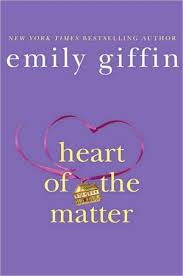
This next book was kind of low on my list and got pushed up after a slightly funny story - I had put Emily Giffin's latest, Heart of the Matter, on my reserve list a few months ago. When it finally arrived (a month after it was published I might add) I got it out and put it in mind to read on the quick side, because as a new book, it would be difficult to renew. Then, about a week later, I noticed it wasn't on my list online so I naturally assumed that there must have been some technical glitch... and I wasn't in a rush to read it at all, because apparently there was no record that I had it out :) so good... so I put it rather farther down on my list, being that it didn't look at all promising... fast forward a few weeks. Tzvi asked me to renew his books because they were overdue, so I did - at which point I got a response, two books could not be renewed because there were hold requests on them... one was Tzvi's and the other one was my Emily Giffin. Oops :) forgot I asked Tzvi to pick it up for me from the library. So it moved up to #1, it being overdue and all.
I had a four hour or so car ride up to CL this week, and nothing to do but read... but that's not an uncommon occurrence and it doesn't always make for a fruitful drive. This time though... I read almost the entire book in the car! So what does that say about this book, you ask? Was it so incredible that I couldn't put it down? Did the writing just grab me and keep me turning the page? Not so much... I'm really not sure what made it so easy to read, if it wasn't the on the larger side font.
Emily Giffin writes relationship books. Really, straight up relationship books, with nothing else in them. Now I have absolutely no complaints to make about this, I'm not really one for plot anyway :) But I read her books because they tend to be pretty much feel good, sometimes romantic, if not chic lit totally girly books... and if you can't tell by now, that's pretty much right up my alley :) This one carried on with the tradition, the whole book was basically about a married couple's relationship along with a single mother's tied in with them. Her last two were about married couples too, but if they were as angsty, I don't remember it. Basically, the marriage isn't in great shape and I really had trouble sympathizing with either side too much. The man was definitely the villain of the two, but I couldn't really get in to the woman's side either.
The problem is, Emily Giffin tries to explore these deep questions about trust in relationships, and what true love is, and faithfulness, but she is totally lacking in what I consider the appropriate moral basis to do so (and yes, that would be traditional frum values :)) So all I can think is, b"h this isn't my life. Yes, you people all have major issues, and there are no easy answers to the difficulties you are experiencing in your relationship - because a relationship isn't *meant* to be easy! It's work... not cookies and milk (as if I have any right to lecture - don't worry, I know I don't :)) but I just don't have patience for these people to sit here and work it out. So basically I spent the entire book being annoyed with the characters and thinking, what's the point?
Her books are actually all like this, with the exception of her second, which has a bit more of a chic litty feel - the rest are all, but I want this, but what's the right thing but whatever, i.d.c. But the rest all come with a satisfying ending at least! and I have a *little* more sympathy with whatever the dilemma is. This one, as I said, just was *not* on my wavelength... b"h for that. And I thought the ending would be a divorce... which was the only saving grace of the book - and I'm spoiling here - it isn't :) In the last chapter, she actually finally gets around to giving the preachy result of all this back and forth. And lo and behold.... a relationship is about work, love comes from years of life together... yes, yes, yes, but why did this take you so long? But at least she gets it right in the end :)
So I did not enjoy this book... but like I said, it was easy reading - and that's because Emily Giffin does a good job with her genre - she's good with all the minutia of daily suburban life, with making it interesting, to some extent at least, if not completely sympathetic. As Huvi would say, she's a good writer, that why I read her :) Fine, I'll give her that...
...but it's not much... for decent writing and ending it right, I award 2.5/5 to this rather disappointing novel by a promising writer
...which I would compare with the cold cuts I ate today - from my usual diet, a food I generally like, if not my favorite in the world, but just not as good as usual today... kind of bland and with a bit of strange taste too
Subscribe to:
Posts (Atom)