Showing posts with label literary. Show all posts

Friday, September 23, 2016

My Kind of World-Building

Well, vacation is over, just a speck in the distant past, but the book reviews remain ahead. One book I am still in middle of (priorities change when vacation ends... really just it worked out like that), but one I finished on vacation, just did not take the opportunity to review while I could. And now, now the memory is fading, the impression not as vivid as it once was, the details are hazy... Oh well, reviews must be done. SO

Continuing my list of favored authors, I picked up Jasper Fforde's latest (yes, his latest - he does take a while to write books :)), the next installment of the Thursday Next books.  Thursday is recovering from an assassination attempt and thus not quite on her game, so that's one fun element lost. But eh, that's not what I read these books for.  What do I read them for? Ah, the cleverness, of course! The books remind me of Terry Pratchett's in that the world they portray is not an arbitrarily imagined future, but a careful satire of our own, where the slightly illogical is transformed into the obviously ridiculous.  The Toast Marketing Board, law enforcement agencies dedicated to books, time travel, and creatures with unauthorized DNA, and (in this book), a stupidity surplus the government keeps an eye on.  All very tongue-in-cheek of course.  The tone is absurd yet subtle, and I enjoy the silly parallels between this world and ours.  Beyond that, there is a cleverness in the plots themselves, somewhat complex threads that all come together nice and neatly at the end.  And all with a light touch and ne'er a whiff of undue tension.

So yeah, that's why I read those books, and I'd say this one lived up to promise in that way.  Anything specific? Well, it didn't take place in the BookWorld, unlike some of the recent ones, which I think was somewhat of a loss, but that's ok.  As I said, I didn't particular enjoy the older, creakier Thursday who seemed somewhat behind Goliath most of the time.  And though  threads were resolved in the end, I thought some felt either anti-climatic or somewhat unfinished (the last one deliberately, as the next book will continue developing those).  But yeah, totally clever, totally funny, totally light fun, as anticipated.

Verdict: 4/5

Thursday, August 4, 2011

Full of Sound and Fury, Signifying Nothing (wow!!!! go me and shakespeare :))

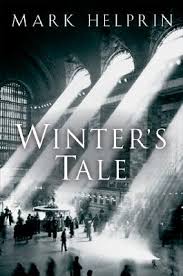
Agghh!!! It's August!!!!! There are a few reasons for me to panic about that, but as promised, I did finish that substantial item on my bibliogenda, and am now ready with a review.  This one was quite a while in the waiting even before I started the book about a month ago (was it that much? Almost, at least).  I really enjoyed Mark Helprin's Freddy and Frederica, I remember laughing out loud more than once (which is surprising for a book that looks like some fairly literary goods).  So I assumed he was one of those "good" authors whose books are actually enjoyable, and I chose Winter's Tale, which seems to be his masterpiece, as my next of his reads.  I got it from Pikesville, returned it six weeks later, got it out from Towson, returned it six weeks later, put it on reserve at the NYPL, let the hold expire, got it out from the NYPL, returned it two weeks later... maybe that wasn't exactly the sequence, but this book is over 700 pages long and there were always holds on it in NY.  It just wasn't happening.  But, you know, fifth time's the charm, and maybe it helps that it's summer, but I was finally able to keep the book out for more than two weeks - which gave me time to actually finish it!

From the beginning, this book was... well, not Freddy and Frederica, that's for sure.  Maybe I was supposed to take that one seriously, but I don't think so, and I certainly didn't - the whole book was a magnificently composed farce, but with a redeeming ending.  Winter's Tale isn't farcical at all - at least, it doesn't seem to be.  It takes itself all too seriously.  At first, I withheld judgement - there was pronouncement after high flown conceit after dramatic foreshadowing, but I figured maybe this was one book that had a right to comport itself in such a grand fashion.  After all, wasn't it supposed to be an epic tale? And at the beginning of the second section, it seemed like my faith was not misplaced - the prose seemed a little less florid, the events a little more everyday, the characters just slightly more sympathetic. That lasted... well, not too long.  Most of the rest of the book alternated back and forth between moments I found myself caring, and passages I was just like, whaa?  The plot made some progress, but for every new development, there were three high flowing descriptions of the city, or of nature, or of some mystical force, or who knows what.

I got less and less patient with the non-story part of the book, but I still held out hope that the ending would be spectacular, rewarding me for slogging through.  There was definitely some potential for it - there was an almost Dickensian complexity of relationship among the characters (like that? :)) and there was a setting of events going a hundred years back.  But to counterbalance that, instead of seeking to tangle things up as much as possible so that we could be stand back and admire as the knot came undone, the book advances more by "magical" elements than anything else.  You wouldn't think I'd be so bothered by the lack of self empowerment in this book, but if felt like the author was some omnipotent being throwing plot twists at his hapless creations.  Now of course that's exactly what was happening, but can you let us forget that for a second? Instead, we are continually reminded that what we are reading is an epic tale, a tale of great scale and grand power, and how do we know that? Because we are told that, flat out pretty much.

And when we finally slog through that momentous build up, here's the shocking part - NO twist.  Or almost no one anyway - we knew Peter Lake would be important, we knew the city of justice would be revealed, we knew the dead would be brought back to life.  What we didn't know was *how*.  And guess what *how* was? It just happened! Peter Lake killed himself, Abigail came back to life, and the city was filled with light.  Huh? Where did that come from? Well the author's head, that's for sure.  It's possible he wanted to write a description of the Messianic era, that's really what it reminded me of more than anything else (or more like a pagan/Christian rendering of one).  But, putting aside that it's not like we can ever know or even imagine what that era will be like, it really doesn't make for very compelling reading.

I actually have an impressively literary explanation for why I didn't like this book.  One of the important elements of narrative literature (thanks yet again, Mrs. Janney!) is conflict.  It can be man vs. man, man vs. nature, man vs. himself... but it's got to be man vs. something.  In the 700+ of this book,  I really couldn't find a central conflict.  So despite the impressive build up to the final "Golden Age" of the ending, the plot just had no footing.

And what about the writing itself? I suppose it was good, if you go for that sort of thing (condescending or what? :)) I mean full beyond of extended metaphors and descriptions of nature, man, time, elements, whatever you want.  Paeans to New York, which were mildly interesting, since I do like New York.  But all of it just seemed like someone trying to make things sound more significant than they actually are.  Trying, and, at least in my book, not succeeding.  Occasionally, there was an impressive turn of phrase, but for the most part, this is the writing parodied by the Bulwer Lytton Content (look it up, and then the Little Lytton Contest - it's even funnier).

I was so confused by how ungood this book was, I went and read the Wikipedia entry.  I found out that 1) it's not considered that amazing and 2) Mark Helprin is really full of himself and more than a little unusual (and that's not because he's a Republican :)) So I guess I just had the wrong impression of the book's place in the American fiction canon.... but it didn't live up to my expectations after Freddy and Frederica either.  Oh well... a month wasted (not really of course, I don't usually regret reading things :))

Verdict: 2/5

PS - http://vellumpire.blogspot.com/2010/04/interim-post-hang-in-there.html we do go back far, me and this book :)

Friday, June 24, 2011

I Heart JA

It's been quite a while since I read an Austenprose pick - Major Pettigrew's Last Stand was the last - so I'm certainly due for one.  And this one is a true Austen, not just some tangentially related female-geared novel.  Claire Harman has written Jane's Fame - subtitled "How Jane Austen Conquered the World". Really, you say? Jane Austen rules the world? Well you know I think so at least :) (to the non-existent readers of this blog, I refer you to an old joke, the tagline of which is "Rochel thinks she's the whole world" - see, girls? I'm not the only one!)  The premise of the book? Tracing the growth of Jane Austen's popularity from her lifetime until now.

Now you know I'm not going to argue about Jane Austen's (or, as we Janeites would have it, Jane's :)) popularity or supremacy is the world of literature.  But it's funny to find that so many of my ideas are shared by others, and have been shared for ages.  The idea that one can be judged on their like and dislike of JA - I have said repeatedly that when it comes to girls, I don't get why anyone wouldn't like P&P.  And I consider it a negative trait to dislike it, of course :) And I certainly feel strongly enough about why I like the book to be offended when others try to interpret it in other ways.  And I get a kick out of hearing how all these famous literati worship Austen.  Okay, maybe it makes me a little cliche, but you know what? I don't mind being cliche.  Besides, there aren't *all* that many people who like JA enough to actually read this book... right?

The book itself is a lot of fun to read.  It starts out as a bit of a biography, since it talks about Austen's notoriety during her lifetime.  But, unlike a biography, it talks mostly about Austen's relationship with the public, meaning it largely avoids the speculation necessary to write a comprehensive biography of the author's personal life.  There were a few occasional indulgences in fancy, but nothing to get me too distracted.  And once the book passes into Austen's posthumous reputation, it becomes almost all fact.  There is certainly a liberal sprinkling of interpretation here and there, but mostly forgiveable.  Only the last chapter, talking about Austen's current rise in popularity starting with the '95 P&P reads more like literary criticism than straight fact.

I have to say I'm often skeptical of what there are of Harman's interpretations/musings, so I'm glad they're kept to a minimum.  She's definitely in sync with me in wanting to paint Austen in the best possible light, but at times (a lot of times), she had me thinking, really? Couldn't I write the exact same book about Charlotte Bronte? To some extent, the answer is definitely yes - the Brontes have their fans, and at times, I'm sure, a much larger fan base.  Still... I bet Jane's is bigger :) In the end of the day, I don't need a book to prove to me that Jane Austen is a universal favorite - I have her books as proof that there's every reason she should be.  Hearing the reasons everyone else thinks so (her writing, her wit, her perspicacity, her exquisite touch, her realism, her feel-good bent...) are a fun confirmation though, most definitely.

Verdict: 3.5/5

Thursday, May 26, 2011

I Love Books About Book Lovers

Delving even further into minor English classics of the mid-twentieth century, 84 Charing Cross Road was another long standing item on my BTRL (Books to Read List, naturellement :)) Again, don't know where I first heard it mentioned, but when I found out it was a non-fiction epistolary style memoir, and that the two people don't even meet in the end (spoiler? sorry :)) I was less than eager to put it at the top.  But I've heard it praised a few times, so I put it on hold.  I was pleasantly surprised when it turned out to be a teeny-weeny 100 page or so paperback, and even more pleasantly surprised when I picked it up on the plane to Mountain View a month ago.  I was kind of reading it to put myself to sleep but I found myself caught up in the writing almost immediately.  Since it was really interrupted reading (in middle of Mark Twain), I didn't pick it up again until a while later, two Shabbosim ago when I was home in Queens.

To begin with, there was definitely an overdeveloped sense of anticipation, since I had found the book so unexpectedly enjoyable.  It was to be expected then, that there would be a sense of not living up to expectations.  I guess that manifested itself in my reaction to the writer, Helen Hanff's, breezy sense of humor.  It's cute and funny, but... maybe a little too blithe? I'm not really complaining, the truth is, how can you complain about a real person? This wasn't someone writing an epistolary novel, this was actual letters from an American... well I suppose spinster would be the easiest way to describe a single woman in the 50's, but she not very spinsterish at all.  She's a writer for television, one with definite intellectual tastes, but one who seems to take life very much in stride and live to enjoy.  On the other hand, there's her correspondent, FPD (can't remember his full name right now) who comes off as English to the core - always polite, very friendly and helpful, but neat and reserved too (yes, we get all that from his letters :)) If it was fiction, it would be the most cliche'd fiction you could find, only redeemable by the couple getting together in the end, but of course :)

But it's not fiction.  FPD is married, and (sadly enough, spoiler alert) dies before Helen can get to England to meet him and his family.  And nothing much happens to Helen either in the twenty years they correspond (unless it does happen and she doesn't tell him of course :)) It seems like there are some letters left out, so there was definitely some effort and grouping the remaining ones into a narrative.  In the end, I suppose it's a pretty sad narrative, not much of a resolution beyond the publication of the letters - but it doesn't feel sad.  Helen and Frank seem to thoroughly enjoy each other, transatlantic though their relationship might be. And I enjoyed them too, I always enjoy people who love books :) Though wow, these books, I have never heard of *any* of them! Except Pride and Prejudice - yes, Helen loves P&P.  And now you know why I love the book :) Okay not really, but I always love it the way everyone loves Jane Austen - Stella Gibbons (Cold Comfort Farm) waxed enthusiastic at one point as well.  In any case, it's surprising how close you can feel to someone after reading their personal letters all about the books they love :) Or at least how much you can enjoy a light, fluffy, collection of them.

Verdict: 4/5

Friday, April 15, 2011

The Man, Myth... Mr. Mark Twaaaain!!!


AAAAAAT LAAAAAAAAAAAAAAST mmm mm mmm mm mm mmm mmm…. (that's the Etta James's song, if you didn't catch the reference)… I'm sure you've all been wondering what's been going on.  I haven't posted since March, and in the process, have missed my one-year anniversary! (April 11).  I know the questions that were running through all of your heads… is Rochel abandoning us? Has she left the labor of love that is book review blogging behind as she heads off to brighter ventures? Was she - gasp - *kidnapped*?! Never fear, loyal followers.  I have merely been reading *the same book* for the past month.  It was a long book, in my defense, over 700 pages.  I only read around 250 of them, towards my condemnation though :)  My hunk of reading material these past weeks has been non other than the newly-published Volume I of… Mark Twain's autobiography.  He dictated that it not be published until 100 years after his death, which came by this past year.  I had to wait through around 300 people on the hold list before me, so when I got it, you better believe I was going to read it.

And I did.  I carried it back and forth for a month, reading it every day on the train.  (My Shabbosim happened to be busy for the past few weeks).  The funniest thing was what a conversation piece a 700 page tome by a famous author can be.  I must have talked to five different strangers about how much I was enjoying it (or not).  I gave them all the same answer - it's great.  Because it was pretty great.  The man is a master, we all know that.  He's one of the greatest humorists ever, and he pretty much invented the American personality.  Maybe a little brash, not as cultured as his European part, but we love him all the same, he's intelligent, he's moral, he's altogether superior.  Mark Twain's characters are like this, and the funny thing (or maybe it's not funny?) is that he is too.  I find myself agreeing with him much, though certainly not all, the time.  His political opinions, his values, he's just seems like he's on the right track.  But it's not like i'm evaluating him for a shidduch, I don't even know why I'm talking about this.

The point is, was the book good? So, first of all,  it wasn't unbelievably good or anything.  I mean, it was an autobiography, i.e. non-fiction (or ostensibly so :)) and therefore, mostly lacking in any driving plot.  And this one was even more lacking than most, since Twain's much trumpeted format is to talk about whatever he feels like at the moment (the book was dictated).  He makes much of this celebrated method, mentioning it at numerous times as the only way to write an autobiography.  And he's right, it keeps the book fresh and light.  And if I can't write a book report on "The Life of Mark Twain" now, I think I have a good idea of the man himself.  Maybe that's why I went off on the above tangent.  The book is really an illustration of his personality, not his biography at all.   

So we're taken on a tour of Mark Twain's philosophies, his memories, and his views on the matters of the day.  The philosophies are sometimes interesting, sometime not so much.  The matters of the day are at times laughingly archaic, at times eerily relevant.  And the memories… well the memories are sometimes tinged with sadness, something achingly poignant, sometimes light and amusing, but always evocative and always exquisitely related.  It's amazing how much we can care about people who died over a hundred years ago, when Mark Twain cares too.   He's definitely right about this format of autobiographing being compelling.  It doesn't move that fast, but it's rarely boring (other than the 10 or so page description of his houses in Florence, which I could have done without).  I definitely feel like I would have liked some more background.  Despite explicitly writing for the audience of 100 years in the future, Twain seems to assume we know as much about him as any of his most devoted contemporary readers.  I don't know about you, but that's certainly not true about me.  So it got a little annoying at times, but only a little.   There was repetition occasionally too, natural in a book that was dictated only by what was on his mind, but, again, only a little annoying. 

Overall, what can I say about this book? Well I'm definitely going to be reading the next few volumes, whenever they're released.  And I'm going to be re-reading his other books too.  Not like I wasn't a Twain fan before, but now, it's personal.

Verdict: 4/5

Wednesday, March 23, 2011

My Kind of Fantasy Land

So if you read the blog even more avidly than all those other people who read my blog, you may have noted my comments discussion with abg, advising her on good reading material for her vacation.  My strongest suggestion was to get in to Jasper Fforde; though it turns out abg was not enamored of his books, I feel like he's one of that elusive few, male authors whose books I like.  The reason, of course, is that his books are comedic.  Not strict comedy maybe, but definitely light-hearted.  They are also very clever fantasy - taking place in an alternative universe where the fictional characters we know and love are real.  Real and living in a world very similar to our own... except that instead of atoms, they have text. The idea isn't that radical.  But the execution is so good. I mean, yeah, I'm the girl whose favorite sporkle category is literature, so I'm predisposed to like it. But come on, metaphor as the elusive element? Gray's Anatomy the hospital? Footnotes as a communication device? It's just cute :)  Actually, abg agreed with me on this; she just thought that despite all this, the books were tense.  And they are tense - they have a bit of the thriller about them, as so many fantasy books do.  But I just don't think it takes it over or anything - or maybe the sheer absurdity of the villains and various hazards just distracts me from any sense of danger.  I think it's like Terry Pratchett in a way - go, British male writers of comedic fantasy! :)

Anyway, that's as far as the series goes (it's the Thursday Next series, by the way, he has some other books too).  I read them a few years ago, and the sixth one just came out.  So first of all, it's not exactly like I remembered everything from the previous books, which was annoying, but you know, you can mostly pick it up (if the author is at all decent anyway).   And with these books, there's so many little cute jokes I miss, it's not like I get everything anyway.  Like in this book, Thursday is bribed to advertise the Toast Marketing Board.   And only then did I realize that though there were constant references in it to previous books, it is never explained what it is - because she went back and added them gratuitously to the narrative! and cute again :)  The point is, even if you don't get everything, there's enough clever little references you will pick up to make yourself feel smart and get a real kick out of the books.  And with this book, it mattered even less than usual... because the book wasn't even about Thursday.

Okay, here's where it gets clever.  So in Fforde's universe, book characters are real.  Thursday Next has had books written about her (in the series, don't worry, it doesn't get that self-referential - at least not yet :)) so she has a fictional self.  So even though when we open up the book and the narrator is referred to (by others I mean, it's first person) as Thursday, it takes a while to figure out that this is not our Thursday.  But the cool thing is that we like her anyway, because she *is* Thursday.  Or if not exactly Thursday, close enough with her that we still feel like we know her.  Actually, I find entire concept pretty mind-blowing.  I mean our Thursday is fictional, this Thursday is fictional, I don't remember the books well enough to notice the personality differences, but still, he tells us this is the fictional Thursday, and all of the sudden I like her, but I feel *just a little* more distant.  Really makes you think about psychological effects and all that.  Oh and the best part of another Thursday was that she totally hero worships our Thursday and it was tons of fun to hear how everyone thinks she's awesome.

So the book was totally brilliant in that respect.  And it had all the hallmarks of a Thursday Next, where the BookWorld mirrors ours so novelly (cute pun, no? :)) and we get to meet all our favorite (and not favorite) larger than life characters.  It had the usual, I suppose tense and dangerous plot, which was as usual not too tense for me because it was just so overblown.  My only complaint was I did feel that some of the cute punny features of the Book World felt a little too pat.  Like, okay, take any vaguely literary detail and insert it in place of something non-literary - presto, the Book World equivalent.  It felt a little too mad-libby at times. But it was okay, it felt just right in others :) And Jasper Fforde shares with Terry Pratchett a predilection for making over science (physics and chemistry) to fit the fantasy world, which of course I like - it's funny how much I like science,  I should really read it more :)  Anyway, that was really my only complaint... so no surprise -
Verdict: 4.5/5

Wednesday, March 9, 2011

A Set of Fangs Doesn't Have to Hurt

If you're a frequent reader, you no doubt have noticed that there is a proliferation of Austenalia out there in bookland.   You are of course not the only one who's noticed - Michael Thomas Ford, for one, came up with the bright idea of an Austen-vampire mashup... obvious, in a way, given that other ubiquitous (okay, far more ubiquitous :)) creature du jour.  Actually, sad as it is, he is not the only one to come up with this - I say sad, because while Ford's novel is completely tongue-in-cheek, and quite funnily so, Mr Darcy, Vampyre and Vampire Darcy's Desire (I think those are the two titles I know) capitalize on the dual trends with an absolute straight face.  Because Darcy is just so much better with fangs.  Anyway, in this case the pairing was made only for for the sake of humor.

Jane Goes Batty (currently under review) is actually the second book in the series.  I read the first last year, I think off a recommendation on Austenblog, because I wasn't reading Austenprose at the time (and Austenblog still had regular posts :( ).  I was slightly hesitant (for obvious reasons, and also because, as always male authors are a warning sign) but I thoroughly enjoyed Jane Bites Back.  It could have gone either way, since a lot of the potential in the situation of Jane as a vampire is that Jane is alive today.  And Jane being alive today means Jane can see what we've done with her books... everything we've done.  So, very realistically, Jane is not altogether enthusiastic about her fandom, at least elements of it.  But there's a fine line to tread here, since what is Michael Thomas Ford, but another lowly plebian trying to ride the Austen popularity wave? In any case, he does manage to tread the line pretty well.  I'm not saying his Jane isn't a little too vulnerable at times and a little too snarky at others, but she's believable.  I think if Jane Austen was a vampire who couldn't reveal her true identity she might well struggle with the lack of appreciation shown her and the sometimes misplaced homage to her works.  I don't think she would suffer from writer's block or have trouble getting her novels published, but okay, it's permissible.

Most importantly, you don't have to take anything these books say seriously, because they don't take anything seriously at all.  The writing is... well if not juvenile, simplistic enough to be understood by the masses so even the most dramatic moments have a kind of drab ordinariness about them.  And right when things start gettings tense, everything just kind of resolves itself without too much effort.  It's great, at least for the book's purposes.  No matter what kind of ridiculous antics everyone is getting up, you can take it because it's all in good fun.  And I think there's definitely room for fun here - I mean yes, I read Twilight and yes, I read Mr. Darcy's Diary et al. - but I know they're kind of silly :)  And Michael Thomas Ford does a good job with pointing that out using just the right kind of gentle jibing.

Besides all this, it's fun to read about Lord Byron, and Charlotte Bronte, and Jane Austen.... like my version of a tall tale :) And the story itself ain't bad either - quite a decent romance going on, if you were wondering (not a real romance of course, the author is a man).  But in any case..
Verdict: 3.5/5

And I totally forgot...
100 POSTS!!!! Yay!! :)

Sunday, March 6, 2011

Ms Austen She Is Not

Continuing with my usual practice of picking up books recommended on Austenprose, I took The Three Weissmans of Westport out from the library when I came across it on the shelf.  I heard about it as a modern retelling of S&S - *not* chic lit - that got rave reviews, and did not bother to reserve it based on the dual signals of S&S and *not* chic lit, but when I saw it, I was like, well why not, rave reviews, huh? So out it came, and it was actually the first of all the (okay, not all that exciting) titles into which I ventured, due to its status as the only book with a hold on it (since, filled I think).  But before I even started it, Chava tried it, and informed me that she found it fairly unfun to read.  Now that was not a good sign, because to Chava, *not* chic lit doesn't spell doom in the same way it does to me.

Anyway, once I started, I was surprised by Chava's opinion.  Being an S&S retelling about two Jewish girls, there was a lot about it that reminded me of Allegra Goodman's The Cookbook Collector.  That title was not a real retelling, just one that purported to be in the spirit of S&S.  It did have two sisters, one the practical one, one the dreamer, so I suppose that classification is not unwarranted.  Anyway, Chava loves Allegra Goodman, while I am not as much as a fan (if you want to know why read this).  So this book was about secular Jews, but still very Jewish Jews, and it was pretty much for women by women about women kind of fare, so I definitely felt the similarity.  But, at least initially, I found T3W (like that? :)) to be much lighter, much less literary and therefore much more fun.  Like, if not chic lit, then at least nothing with any pretensions beyond a desire to entertain.

That was in the beginning.  But as the S&S plot dictates, the story got more serious.   And as the plot thickened, the characters... whined.  I mean, I don't like Marianne even in the original.  But Eleanor's all right, and I have nothing against Mrs. Dashwood.  But here it was like, I don't know why anyone finds Miranda endearing, she is, as she styles herself, a nightmare.  And as for Annie, it's not like you have to be pathetic, secretly sorry for yourself, and kind of dull just because you're more practical than your sister is.  So, as S&S isn't exactly laugh-a-minute fun anyway, here we have a tense story with annoying people taking center stage.  And as for light... not a whole lot of fluffiness, and very little dark humor to lighten the mood either.  Meanwhile, the book got more and more, I don't know if you want to call if more philosophical, more pretentious, but more happy to make blanket statements about life and whatnot.  The one I was really unimpressed by was on page 118 - I remembered the page so I could refer to it later... but I now don't feel like getting the book out of my bag to cite it, so I guess you'll just have to go look it up yourself to satisfy your curiosity :) But anyway, the point was, instead of being a more light and funny take, it was this heavy handed adaption... with not much point, because it's not like any of the Weissmans are realistic and relatable or like their story is a common tale.

At one point, I was thinking, maybe it's my fault for getting this out - after all, S&S is my least favorite Jane Austen.  I haven't read it in a while, and my presumption has always been that I would develop more toleration for it rather than less, since that's been the general trend for me for a while.  But here's the thing - S&S was enjoyable reading even when I read it last in 12th grade - I just hated the ending.  The two romances are neither of them at all decent by my standards.  Eleanor and Edward know they love each other from the beginning, their obstacles are no source of decent angst, just annoying.  And as for Marianne... she doesn't even love Colonel Brandon at the end, and who cares about her anyway, she's an idiot.  But like I said, Jane Austen is Herself, and she keeps it light.  Not here.  It's almost blasphemous the way these whiny authors think they are carrying on the comic tradition on Jane Austen.  Or maybe they don't think so, they just like recycling her plots.  If that's the case, I have plenty of sympathy. Nothing I like more than a good modern retelling of P&P. But when they choose S&S, I suppose I have to be on my guard, at best...   I mean, it's simply not a plot I love (which won't stop me from watching From Prada to Nada, of course :)).  But here's the kicker - after a whole book of tense whining and depressed moments, we are finally supposed to end up with Eleanor and Edward, and Marianne and Colonel Brandon, right? Wrong, apparently.  She goes ahead and changes the ending! Why? I don't know, I don't think it really adds much thematic value.  Maybe she thinks her way is more realistic? I think it's mostly just for shock value.  But unfortunately, since I had pretty much lost interest in the book by that time,  I don't know if I cared enough to be really shocked.  More like disappointed.  Is nothing sacred? Okay, that was facetious, but seriously, this book was no good enough to merit its own ending.  And I am therefore demoting it from 2 to a

Verdict: 1.5/5

Sidenote: I looked back at the review on Austenprose, and it turns out she was not one of the rave reviewers - she thought pretty much the same thing I did, and she gave it 3/5, which is quite low for her. I really should read those reviews a little more carefully :)

Saturday, January 15, 2011

P&P Cute as Can Be

As you may have noted in the post below, the next book on my list after that infamous one was another from the P&P genre, again recommended on austenprose.  This one is a modern take on P&P - that's another category that always peaks my interest.  I sent a link to Sarah Sp., and she not only promptly ordered it, she made sure I got to read it first - really Elisheva read it before I did but that's because I didn't go pick it up.  And she left in for me to pick up before she left on her trip so I felt very much in debt to both those wonderful girls for their considerate care - thanks :) Anyway, this one is a YA novel... I feel like that's been done before but I can't recall that I've read any previous takes.  So there was some excitement in it, tempered by my ambivalent attitude toward YA chic lit.  I mean, come on, we all like a little fantasy, but does anyone believe in happy-ever-after for these guys? More like happily-until-graduation at best... And of course there's the thing that I just find high school drama overly compelling - I mean, of course I sympathize with their friends issues and their parents issues and their college issues... but that's all so over for me I just have a hard time getting in to it (am I being an old crone? I don't think so, so maybe there's something else I just find uninteresting? No it's pretty much that I have no patience for people who I simply view as immature babies - and yes, I know that to much of the world, that's exactly what I am :)).  Anyway, the point is, it's not like I was expecting *that much* from this book.

Actually I feel like I knew exactly what to expect from this book:
1) YA - so inherently less interesting, see above
2) Pride and Prejudice - so a great romance :)
3) Pride and Prejudice retold - so somewhat off-tune at times, where the details are a bit forced.
And that pretty much sums up what I got, so brilliant me :) You know, I just realized I haven't posted the book title yet - it's Prom and Prejudice, by Elizabeth Eulberg.  Anyway, right off, I got annoyed because the main character was a teenager in a fancy school who doesn't really fit it in - so we've got #1 right off - high school angst up to the ceiling.  Besides that, I didn't like that she was the one who didn't fit in, the uncool one - Elizabeth may not be as rich as Darcy, but she's pretty much it in her sphere.  And she's pretty happy with her life as it is - other than the fact that there's no one for her to marry of course.  But trust me, if she was writing a book, she would not launch into complaints about her neighbors within the first two pages... That being said, Lizzy in this book doesn't hate her life that much... she has a chip in her shoulder about her ridiculously entitled classmates, but then Elizabeth has a bit of chip in her shoulder too... when it comes to Darcy at least, not really any place else that I've seen.  And more about her ridiculously entitled fellow students - that's shades of #3, where the story is stretched to fit the P&P plot.  Of course fancy boarding schools are full of snobby kids... but as nasty and at the same time as vanilla (not like we're talking drugs and whatnot) as these? nah... and I feel like part of the reason the setting is just so over the top was that the point of the book was more modern P&P than realistic and compelling high school tale.

....But why would  I complain about that? I have zero interest in compelling high school novels :) And yes, there was lot that felt forced about this book... Darcy for one does *not* seem like a seventeen-year-old.  And Wickham's evil influence on the weak and vain Lydia? Yeah, it's not the Girl Scouts, but she isn't exactly ruining her sisters' chance at a normal life forever... But the truth is, forcing is really a natural product of trying to turn a nineteenth century novel by a master writer into anything else... I am even ready to be *slightly* more forgiving of Regina Jeffers... well maybe not.  But when you read a P&P inspired book, you just can't complain that it's not as good as the original.  And more importantly, you can't complain that it's not as good as other books of its "other" genre, because they really have another goal in mind.  So I definitely give Prom and Prejudice some slack when it comes to eye-roll worthy situations.  And there were a few of those, but nothing too overwhelming really.

So #1 and #3 were right there... what about #2? And of course, since that's the reason I read this book, that is of course the crucial question.  Drumroll please.... Yes! We had #2.  Quite a decent romance.  I mean, totally cutesy of course, this being high school, but Darcy done right, even as a teenage boy, is still dreamy :) Dignified but such a softie underneath :) wise, kind, handsome, capable... oh come on, he's Darcy :) Can you see I can't stop smiling? I don't know why you'd expect anything otherwise.  Okay, I'm getting a little too rhapsodic, because of course Will Darcy the Pemberley Academy student is not Fitzwilliam Darcy of Pemberley, Derbyshire, but he's nothing to sniff at.  And he loves our Lizzy of course.  Our Lizzy herself is not a bad sort either - she's smart and capable and phenomenally talented musically, which was a nice bonus.  So yeah, it was a good story.  But it was high school after all that.  There's just no angst, because there can't be.  Even I can't suspend my disbelief enough to think anyone's lives are going to be materially affected if these characters never get over their initial, unfounded, dislike.

I'd say the best I could say about this story is that it's cute.  Not that there's anything wrong with that, but I've read even some regular old chic lit that I'd give a higher rating than cute too... not that much, admittedly.  And on the plus side of recommendation, Huvi and S.b. both read this over Shabbos too, and they both thoroughly enjoyed it.  Found it cute as I did, but apparently don't have the same hang-ups about high school and so were able to enjoy it a bit more thoroughly.  Bottom line: I'm not telling you you have to read this, but I'm pretty sure if you take the very minimal time it takes to get through it (we're really talking an hour or two), you won't regret it.

Verdict: 3/5

Friday, January 14, 2011

So Bad It's… No, It's Bad


OMG I have been DESPERATE to write this review! So as you probably know, one of my chief sources for books these days is Austenprose.  There are a million and one P&P paraliterature books coming out lately, but I only find certain of them interesting - specifically, I have no interest in prequels or sequels, but I am a dedicated reader of same-quels (like that? :)).  I had read up to this point six - yes 6 :) - versions of P&P from Darcy's POV.  Some are better than others of course, all are not worthy of being mentioned in the same multi-volume tome as the original, but all of them up till now have been pretty fun.  So it wasn't like I was going to say no to yet another one - Regina Jeffers's Darcy's Passions, this despite the fact that she has published other P&P-inspired books and I had no interest whatsoever in reading them.  Anyway, I put it on reserve at the library (this was the third of the three reserves I picked up right before I left to Israel) and started it on the plane on the way back from Spain.  It took me a while to finish, but that's par for course these days, doesn't necessarily say anything about the book… and my main complaint with this book was not that it was boring.

So what was it about it then? WHERE DO I START?! Seriously, this is HANDS-DOWN the WORST book I have EVER finished, and quite possibly the worst book I have ever STARTED.  Are these caps annoying you? Take that twinge of impatience and multiply it… then raise it to the same power… and do whatever else you have to do until you're shaking your head in DISBELIEF… In the introduction to the book (yes, the book has an intro. :) - I can't even say that without shaking my head :)) the author states that she has taught in English literature.  I actually flat out do not believe her.  The grammatical errors in the text are *egregious*.  Aliza cited misplaced modifiers, but I don't even know what those are.   She made the basic mistake of using the inappropriate subject after a intro phrase (don't know the technical term, but it's the one for phrase like this : "Although handsomer than Mr. Bingley and now rumored to have 10,000 pounds per year, most of the assembly found him…") Then there's the complete misuse of transitions like "yet" and "however", when in fact the phrases in questions are either complete non-sequiters or in need of no transition whatsoever.  And seriously, is she UNAWARE that there is exists a tense known as PAST PARTICIPLE, to be used when referring to a continually occurring circumstance, so that it doesn't seem like we are flipping back and forth between two times and two locations… unless this rewrite contains the addition of a time machine? (man, I'm having fun with my scathing condemnation :)) 

Moving on from grammatical concerns, we have the next favorite red-pen markup to worry about - "word usage!" Sometimes it's a weird tone, sometimes it's unwieldy, sometimes, sometimes it's funny, and sometimes it's *just plain wrong*. Take this one - I read it aloud to various people and burst out laughing each time - "howbeit pale" - that's just an excerpt from a longer passage, but seriously… I actually don't have a clue what she meant to be saying with that one. Anyway, the list goes on - I'm just flipping through it looking for these examples and I amazed all over again.  Over and above the clumsiness of the wording, there's blatant anachronism littering the pages.  "I bet", "phenomenal father", "you're amazing" ?! Since when does P&P take place in current-day America (and yes, I know there are multiple versions that do - I will be reading and reviewing another one shortly :)) I definitely have a bee in my bonnet about anachronisms, but HOW MUCH EFFORT DOES IT TAKE to say "I surmise" instead of "I bet"?! It seems like nothing but deliberate disregard for historical accuracy, which the author may find cute but which I find slightly repulsive - really, that bad.  

So what else do we have? Well there's her completely inaccurate portrayal of Darcy, Elizabeth, and everyone else in the book.  But it's not like I could really expect anything better.  Any time you read something like this, you're risking a totally skewed portrayal of the characters - yes, this one was worse than most, but I don't know if I can even complain… All right, I can complain - Elizabeth was alternatively flirtatious and idiotic and Darcy was by turns maudlin and overly-anxious.  Whatever it was horrible.  And that was before they got married.  The author takes it upon herself to continue the story after they get married at which point the characters become UNRECOGNIZABLE.  And not just unrecognizable and Darcy and Elizabeth, fairly unrecognizable as human either.  They sit there swooning over each other and declaring their love ad infinitum.  We know, we've heard, we don't even care anymore, and can this book pleeeeease be over so I can write my review? 

There was literally nothing to like about this book.  I think one time (can't remember where), I thought there was a fresh take on one the scenes… so it wasn't all bad from start to finish, I *guess*.  But it pretty much was.  Literally, I was just sitting on the train and shaking my head as I read, alternatively wincing and grinning in disbelief.  I guess in the end of the day, I enjoyed hating a book so much… and I did get through it, and got to this fun part :) Congratulations to me!

Verdict: 0/5 (Earlier in the reading I was going to give it a 2 for being "so bad it's good" but I couldn't.  I just couldn't.

Thursday, September 16, 2010

Lamentations on The State of Literature

After the previous months' reading, consisting of either junk or girly classics, you must be wondering, does Rochel ever read any quality literature? An excellent question - and one to which the short answer is yes, when I get around to it.  Having read all my good library books and treated myself to a few old favorites, I finally got around to reading one of my man books, which is due pretty shortly.  As I've said before, I prefer woman writers in general, but I like male "funny guys" - see my earlier post about Terry Pratchett, etc.  Peter Carey came up on a list of authors matching the keyword "Australia" at my library's search engine.  My Life As a Fake seemed to be the kind of satirical and lighthearted material to which men are best suited and which I often enjoy, so I got the book out as potential entertainment for my down under journey.  Of course, I didn't get around to reading it till a month later…
…and I must say that while it did live up to its promise as an Australian novel, that is *all* it lived up to.  Let me just talk about that a little first - although the book takes place in 1970's Malaysia, a place about which I know very little and about which I wish I knew even less after reading this book, one of the central characters talks extensively about his earlier life in Australia.  Mentioned are, among other places, Queensland, Townsville, Melbourne, Sydney, Bondi, St. Kilda, the Australian Hotel, Darlinghurst, the Harbor Bridge, Warrnambool… so it was definitely exciting to have been to all those places.  But DO NOT read this book, even if you've been to Australia and want to relive the glory.

Peter Carey is considered a pretty literary author.  He's won the Booker Prize, which I think is the English equivalent of the Pulitzer *twice* (and he's considered a long shot to win this year actually).  He has a plaque in Sydney harbor (that got me pretty excited when I saw it, I admit) and the little blurbs all laud him as a master.  I have no idea why.  The writing itself… well I guess it was pretty powerful and it moved along pretty quickly but I found it needlessly confusing and hard to understand.  I get that's the effect he was trying to create, but I think it does more to obfuscate (like that bit of poetry? a nod to a central issue in the book, the definition of great verse :)) And more than needlessly confusing, absolutely, completely, needlessly and extremely crude.  I mean seriously - is it really great literature just because its so completely off-putting in every way? Disgusting, dirty, cruel, malevolent… none of the characters was at all likable, nothing good happened, the scenery was repulsive.

I just don't get the point of this book.  It doesn't even have a discernible theme.  There seems to be no moral lesson, just an obsession with evil and reprehensible behavior.  I mean bad isn't rewarded, not by any means, but it's not like divine justice pays back, just that nothing good happens period.  These people all have miserable lives and they behave miserably.  Why would I, why would *anyone* want to read about this? I really don't get it.

Verdict: 1.5/5 (.5 because the writing wasn't junk writing, I'll admit that)
Food: something gross and repulsive that some people seem to like, but I don't get why - how about that plain yogurt I ate in New Zealand.  Full of bacteria, tastes gross, but some people claimed it was edible, even somewhat decent. (yes that was a jab at those some people, dear to my heart as they are :)) 

Saturday, July 17, 2010

Imitatation is the Sincerest Form of... Well I Don't Know, but It Works

Well... it's definitely been longer than I thought it would be before I got to this promised double feature.  I can only say, I'm sorry, and not only for the delay, but because I cannot promise the quality of this review will be quite up to par, since I've somewhat forgotten what I thought of the first one in the first place - the second is quite fresh in my mind (I wonder if there's a/1 who knows what that phrase brings to my mind - it's totally obscure, so I doubt it, but it made me smile) because I only finished it last night... which is why I can only post now... so with that in mind, feel free to continue...

So as I've mentioned, Paula Marantz Cohen's Jane Austen in Scarsdale and Laurie Horowitz's The Family Fortune are both modern retellings of Persuasion.  So there is no question that I would like both these books, since Persuasion is one of the three most romantic books ever written (okay, maybe a bit of an exaggeration, but it is *good* - which is why there are modern retellings of it (there's actually a third that I know of, Melissa Nathan's Persuading Annie, but my library didn't have it, so it's not being reviewed here at the moment)).  Anyway, I've read both of these before, I think JA in S I read in like 12th grade or something, and TFF a few years ago, and I enjoyed both so I was happy to read them again.  And I did enjoy them.

But here's the interesting thing - the first one I read, Jane Austen in Scarsdale, wasn't even such a romance! I mean there was a bit of a romance there, but I don't think I would have slogged through the rest if I hadn't enjoyed it.  But I did, thoroughly - the main character is a high school guidance counselor in Westchester, so she basically spends her whole life helping kids get into college.  I mean I definitely got annoyed with a few things about how it was written - one, that the author is not exactly a young thing, and it kind of shows in the way she writes about teenagers, and second, that I hate books that make a huge deal out of what college you go to and all that - makes me feel inferior.  To some extent, the book was making fun of the attitude, but I think it actually made a bigger deal of how these parents approach college applications.  But that was more in the beginning, and as I read, I think the book hit mostly good notes in writing a humorous saga of those tense high school years.  And I liked the main character, Anne, and I definitely liked Ben a lot - so it was good.  funny, romantic and good.

The first thing that struck me about The Family Fortune, as opposed to JA in S, was that it is really a carbon copy of Persuasion.  With JA in S, the main characters were basically the same- woman with mean father and sister, fallen down in the world, and the nice guy she jilted, but it wasn't like it was the same book.  But TFF took Persuasion and transplanted it from the 1800's English countryside to modern old-money Boston.  The back story here is the editor of a literary review, which wasn't quite as fun as the high school scene, but it was a much less major part of the book.  Here it was like, oh so Lindsay (aka Louisa) wants to ski the black diamond (aka jump down the stairs at Lyme) even though it dangerous b/c she's reckless.  And when they pass Guy Callow, (aka Mr. Elliot), Miranda (aka Elizabeth - I almost forgot that name - *blush*)'s old flame, he offers Jane (aka Anne) admiring look... tough I'm not sure Max, aka Captain Wentworth, notices... and it goes on.  The level of detail she manages to transcribe is fairly impressive, I think.  But interestingly enough, as much as the plot follows the original so meticulously, I have some definite objections (another obscure reference here) to the parallelism - namely, the characters themselves.  First of all, I think Jane's position is much more pathetic than Anne's - she really does just sit at home doing very little (I mean she has her work but not much of a life outside that) and unlike Anne, she did have a choice.  And the fact that she didn't take that choice makes her into much more of a decrepit old maid than I is, I think.  And then there's Max.  Captain Wentworth is a good match for a 27 year old, not in her first bloom, whose family was foolish enough to lose their money (not a direct quote, but that's the gist), but he ain't no Mr. Darcy. Max on the other hand... best-selling celebrity author who's also rather gorgeous? yeah, pretty up there on the the scale.  I mean it's not a huge deal, and it kind of makes the story all the more fun, but it was definitely a discrepancy in my book.  But whatever, still fun to read and I liked how it followed Persuasion so closely.

One thing though is that neither book came *close* the original in that *unbelievable* ending - but of course, that's not actually possible... given that "you pierce my soul, I am half agony, half hope" is one of the most beloved Austen quotes ever (and I know this because one time I saw a contest online with name your favorite Austen quote (I think I've mentioned it here already actually) and quite a number of people named that quote).  But in any case, it wasn't surprising that they couldn't equal that ending, but maybe they should have gone in a different direction altogether - since I should think it as possible to get Pemberley by purchase as by imitation :) (okay, okay, I know that was uncalled for, but I couldn't help it :))

Whatever, they were good books - and I liked that one of them was a minutely detailed update of Persuasion while the other one mostly tried to catch its spirit- more variety that way.  And they were totally different in tone as well, with JAinS much more humorous than TFF.  Both romantic, those I'd definitely have to go with TFF as the more romantic one, not surprising since it follows Persuasion so exactly.  But both good, definitely both good.

So verdict: 4/5 on both (I think I'm trying to reserve 5/5 for real classics)

And food... well good food - again, not 5/5, but good food - maybe like Hershey's chocolate - not Swiss, but I'm not going to say no to it on any day ;)

Monday, July 12, 2010

Coming Soon

Hey, readers! I know you guys are like all... it's Monday! What did Rochel read over the weekend? Why hasn't she posted? Good questions, all, and I thank you for your interest... and don't worry, you will be rewarded :) This Shabbos I read Paula Marantz Cohen's Jane Austen in Scarsdale and started Laurie Horowitz's The Family Fortune.  Besides authors with very Jewish names, these books share common source material - none other than my favorite author (or the author of my favorite book - is that the same thing? an academic question.... :))'s second-to-best book, Persuasion... and since 1) they are so similar and 2) I deliberately got them out together because they are so similar, I will be reviewing them *together* - yes a double feature! :) - when I finish the second one... so hold on tight - I'll be back before you know it :)